
Choosing between a 1-motor and a 2-motor (infinite position) lift chair is a crucial therapeutic decision that directly impacts orthopedic health and circulation, especially for napping.
- Dual-motor chairs offer independent backrest and footrest adjustments, which are vital for achieving specific therapeutic positions that single-motor chairs cannot.
- A proper fit, particularly correct seat depth, is more critical than any motor for preventing slips, reducing joint strain, and ensuring stability when standing.
Recommendation: Prioritize chairs with independent controls (dual-motor) and insist on a professional fitting to transform your chair from simple seating into a tool for daily health management.
For many seniors, the long hours spent sitting can lead to discomfort, joint strain, and a decline in mobility. A lift chair is often seen as the obvious solution, a piece of furniture that simply helps you stand up. However, this view barely scratches the surface. The real conversation isn’t just about standing assistance; it’s about preserving health and independence. The risk of falls is a serious concern, with data confirming that one in four adults aged 65 and older experiences falls annually. A well-chosen lift chair can be a key part of the solution, but the market is filled with confusing terms like “2-position,” “3-position,” “infinite position,” “single-motor,” and “dual-motor.”
This guide moves beyond a simple feature comparison. We will reframe the choice between a 1-motor and a 2-motor lift chair as a critical therapeutic decision. The true question is not “Which chair has more features?” but rather “Which chair can become an active tool for managing orthopedic health, improving circulation, and maintaining functional mobility?” The secret to superior back support and restorative naps lies not just in the number of motors, but in how the chair’s specific design allows for precise, health-focused adjustments throughout the day. This is about choosing a partner for your well-being, not just a place to sit.
This article will delve into the specific mechanics and health benefits that differentiate these chairs. We will explore everything from edema reduction and proper measurement to fabric safety and advanced positioning, providing the knowledge you need to make an informed, health-first decision.
Contents: 1-Motor vs. 2-Motor Lift Chairs: An Orthopedic Specialist’s Guide
- Why Infinite Position Chairs Reduce Edema Better Than Standard Recliners?
- How to Measure Seat Depth to Prevent Slipping out of a Lift Chair?
- Leather vs. Performance Fabric: Which Is Safer for Incontinence Issues?
- The Wall-Hugger Myth That Leaves Seniors Trapped Against the Wall
- When to Use the ‘Trendelenburg’ Position for Blood Pressure Management?
- How to Blackout a Senior Bedroom for Deeper Restorative Sleep?
- Furniture Risers or New Chairs: Which Is Best for Easy Standing?
- How to Maintain Functional Mobility After 70 with Low-Impact Home Exercises?
Why Infinite Position Chairs Reduce Edema Better Than Standard Recliners?
Edema, or the swelling caused by excess fluid trapped in the body’s tissues, is a common and uncomfortable issue for many seniors, particularly in the lower legs. While any recliner that elevates the feet can provide temporary relief, an infinite position lift chair offers a significantly more effective therapeutic solution. The key difference lies in the independent control offered by a dual-motor system. Standard or single-motor recliners link the movement of the backrest and the footrest; as you recline, the footrest rises in a predetermined ratio. This limits your ability to achieve a truly therapeutic position.
An infinite position chair, powered by two separate motors, allows you to adjust the backrest and the footrest independently. This means you can raise your legs to a level higher than your heart while keeping your back at a comfortable, slightly upright angle for reading or watching television. This specific posture is crucial for leveraging gravity to encourage fluid to move away from the extremities and back into circulation. As Josie Rhoades, Vice President of Clinical Operations at BrightStar Care, explains, “Seniors often require the use of a lift chair because the chair’s lifting and reclining positions help elevate their legs to reduce the excess buildup of fluid and improves circulation in their legs.” This level of precise, customizable elevation is something a standard recliner or single-motor chair simply cannot provide, making dual-motor chairs a superior tool for active circulatory management.
How to Measure Seat Depth to Prevent Slipping out of a Lift Chair?
While motors and positions are important, the single most critical factor for safety and orthopedic support is the chair’s fit. An improperly sized chair can negate all the benefits of a sophisticated motor system. The most crucial measurement is seat depth. If the seat is too deep, you’ll be forced to slouch to get your back against the backrest, causing poor posture and back pain. More dangerously, it can cause your pelvis to tilt backward, making it difficult to maintain a stable center of gravity when using the lift function to stand. If the seat is too shallow, your thighs won’t be properly supported, leading to instability and pressure points.
This lack of support is a primary reason seniors may feel they are “slipping out” of their chair. Proper seat depth ensures your weight is distributed correctly and that you are positioned securely for the lift motion. The image below illustrates the simple yet vital technique for checking this fit.

As the image demonstrates, the goal is a precise gap. This ensures the seat edge isn’t pressing into the sensitive nerves and blood vessels behind your knees, while still providing full thigh support. Getting this measurement right is a non-negotiable step in selecting a safe and comfortable lift chair.
Your Action Plan: Verifying Correct Seat Depth
- Sit back fully in the chair, ensuring your lower back is firmly against the backrest.
- Check for a gap of two to three finger-widths between the front edge of the seat cushion and the back of your knees.
- Confirm that your thighs are fully supported by the cushion without the edge pressing into the back of your knee.
- Verify the seat isn’t too deep, which causes a backward pelvic tilt, or too shallow, which feels unstable for standing.
- Test the lift function to ensure your center of gravity feels stable and secure throughout the entire rising motion.
Leather vs. Performance Fabric: Which Is Safer for Incontinence Issues?
For seniors who may deal with incontinence, the choice of upholstery is not just an aesthetic one—it’s a matter of hygiene, skin health, and safety. While traditional leather seems like an obvious choice for its wipe-clean surface, modern performance fabrics often provide a safer and more comfortable long-term solution. Leather’s non-porous nature is excellent for initial cleanup, but it has significant downsides. It doesn’t breathe, which can trap moisture and heat against the skin, potentially leading to skin breakdown. Furthermore, when wet, leather can become extremely slippery, increasing the risk of an unstable transfer out of the chair.
Performance fabrics are engineered specifically to address these challenges. They typically feature a multi-layer design with a waterproof inner membrane and a breathable, soft-touch top layer. This construction allows for easy cleanup while also permitting air to circulate, keeping the skin cooler and drier. Many of these fabrics also incorporate antimicrobial properties to inhibit bacterial growth and are designed to withstand frequent, rigorous cleaning without cracking or degrading like leather can.
Case Study: Mcombo Chair’s Advanced Fabric Technology
The Mcombo Electric Power Lift Recliner is a clear example of how fabric technology has evolved for senior care. Its upholstery options include advanced performance fabrics designed for both easy cleaning and breathability. Crucially, the chair is available in three distinct sizes to accommodate different body types (from 4’6″ to 6’2″), reinforcing the principle that proper fit is paramount. Features like an extended 4.7″ footrest for circulation and TUV certified actuators with heat and massage show a holistic approach, but the foundation is a durable, hygienic fabric on a correctly-sized frame.
The following table provides a direct comparison of key features for managing incontinence.
| Feature | Leather | Performance Fabric |
|---|---|---|
| Initial Wipe-Clean Ability | Excellent – Non-porous surface | Good – Waterproof membrane |
| Skin Temperature Impact | Increases temperature & moisture | Breathable top layer maintains comfort |
| Slip Risk When Wet | High – Becomes slippery | Low – Maintains grip |
| Bacterial Growth Prevention | Limited protection | Antimicrobial fibers inhibit growth |
| Long-term Durability | May crack with repeated cleaning | Designed for frequent washing |
| Seam Integrity | Standard stitching vulnerable | Heat-welded or inverted seams available |
The Wall-Hugger Myth That Leaves Seniors Trapped Against the Wall
In an effort to save space, many seniors are drawn to “wall-hugger” lift chairs. The marketing promises a chair that can fully recline while needing only a few inches of clearance from the wall. While technically true, this feature comes with a hidden danger that can compromise safety. The myth is that these chairs require *no* space; the reality is that even the best designs have a minimum clearance requirement. For example, some popular models state that wall-hugger designs still require clearance from the wall, sometimes as little as 1.4 inches, but that space is non-negotiable.
The problem arises when an object—a dropped book, a slipper, or a walker—falls into this small gap. The chair’s mechanism, designed to slide forward on a track, can become blocked. Worse, if the user doesn’t notice the obstruction, the powerful motor can jam, trapping the user in a reclined or partially lifted position. For a senior living alone, this can quickly become a frightening and dangerous situation. A non-wall-hugger model, which requires more space (typically 12-24 inches), creates a safer, more accessible perimeter around the chair, making it easier to retrieve fallen items and eliminating the risk of the mechanism becoming jammed. The small amount of floor space saved by a wall-hugger is rarely worth the potential risk of entrapment. As a general rule, ensuring the area is clear is a critical safety practice. Josie Rhoades of BrightStar Care advises, “Avoid cluttering the space the chair is placed in to reduce the chance of a senior falling when walking towards their lift chair.”
When to Use the ‘Trendelenburg’ Position for Blood Pressure Management?
Some advanced dual-motor, infinite position lift chairs offer a highly specialized feature: the Trendelenburg position. In this position, the entire chair tilts backward, elevating the feet and legs higher than the head, which remains in line with the torso. This is different from the “zero gravity” position, which raises the legs but also angles the back. The Trendelenburg position was historically used in medical settings to manage sudden drops in blood pressure (hypotension) or shock by using gravity to help return blood flow to the heart and brain.
However, it is absolutely critical to understand that this is a medically-significant position that should never be used without explicit approval from a physician. For individuals with certain conditions, such as congestive heart failure, COPD, glaucoma, or acid reflux (GERD), using this position can be dangerous. It can increase pressure on the heart and lungs or raise intraocular pressure. Therefore, while the availability of the Trendelenburg position highlights the therapeutic potential of a dual-motor chair, its use must be prescribed. For most users, the standard leg elevation (with feet above the heart) is sufficient for managing edema. The Trendelenburg position is a powerful tool, but one that requires medical supervision. On a practical note, financial assistance may be available for the chair itself; Medicare may cover the lifting mechanism portion of the chair, potentially resulting in significant savings.
If you are considering a chair with this feature, you must consult your doctor. Be prepared to discuss the following points:
- Never use the Trendelenburg position without explicit medical approval.
- Inform your doctor if you have congestive heart failure, COPD, respiratory conditions, GERD, or glaucoma.
- Offer to document your blood pressure readings in different chair positions for your doctor’s review.
How to Blackout a Senior Bedroom for Deeper Restorative Sleep?
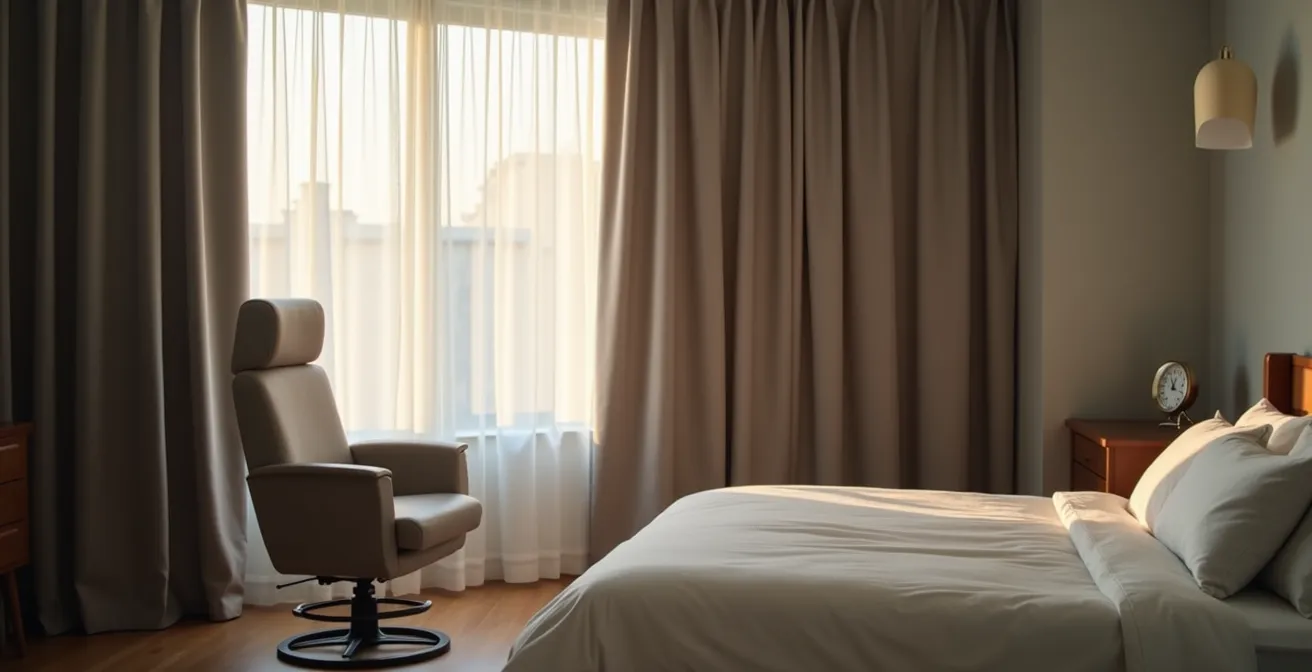
While the lift chair is often associated with the living room, its role in promoting sleep quality makes it a valuable asset in or near the bedroom. Many seniors find it difficult or painful to sleep lying flat, and a high-quality lift chair can provide an ideal environment for restorative naps or even a full night’s sleep. To maximize this benefit, creating the right environment is key. The single most effective environmental change for sleep is achieving near-total darkness. Light is a powerful signal to the brain that it’s time to be awake. Even small amounts of light from streetlights, digital clocks, or electronics can disrupt the production of melatonin, the hormone that regulates sleep-wake cycles.
Achieving a true blackout environment involves more than just standard blinds. Investing in high-quality, heavy blackout curtains that wrap around the sides of the window frame is the first step. You should also address small sources of light pollution within the room. Cover or remove digital clocks, unplug night lights, and place black electrical tape over the tiny indicator lights on televisions or chargers. The goal is to create a space so dark you cannot see your hand in front of your face. This level of darkness encourages deeper, more restorative sleep, whether it’s for a 30-minute nap in your chair or a full eight hours in bed.
Case Study: Chair Features That Support Sleep
The Serta 525 Infinite Position model exemplifies how chair design directly supports sleep. Its dual-motor technology allows a user to find the perfect pre-sleep position, independently adjusting the back and footrest to relieve pressure points. Features like gel-infused memory foam maintain comfort and regulate temperature during long periods, while a quiet push-button remote ensures adjustments can be made without jarring the user out of a drowsy state. As Josie Rhoades of BrightStar Care notes about such chairs, “Because it reclines so far, this chair is ideal for napping and helpful for seniors who aren’t able to sleep lying flat in a bed.”
Furniture Risers or New Chairs: Which Is Best for Easy Standing?
When standing becomes a challenge, many people first consider furniture risers as a low-cost solution. These simple blocks placed under the legs of an existing sofa or chair can raise the seat height, reducing the distance needed to stand. While inexpensive, risers are a passive solution that fails to address the underlying problem of muscle strain and fall risk. Standing from a raised but static chair still requires a significant, forceful push-off using the arms and legs, which continues to put stress on aging knees, hips, and shoulders.
A lift chair, by contrast, is an active solution. The motorized mechanism does the work of lifting, gently guiding the user to a near-standing position with minimal physical effort. This dramatically reduces joint strain and, more importantly, provides a stable, controlled movement that significantly lowers the risk of a fall. Risers can actually increase fall risk, as they can make a chair less stable, especially on uneven floors or carpets. While the initial cost of a lift chair is higher, it is an investment in long-term safety and joint preservation. Furthermore, the robust engineering of a lift chair is designed for this purpose; most lift chairs can support between 300-600 pounds, a testament to their stability.
The table below outlines the stark differences between these two approaches.
| Factor | Furniture Risers | Lift Chairs |
|---|---|---|
| Initial Cost | $20-$50 | $1,200-$2,500+ |
| Physical Effort Required | High – forceful push-off needed | Minimal – motor assists |
| Fall Risk | Increased – unstable on uneven surfaces | Reduced – controlled movement |
| Medicare Coverage | Not covered | $200-$300 partial coverage available |
| Long-term Joint Strain | Continues stress on knees/back | Reduces strain significantly |
| Installation | Simple DIY | Delivery and setup included |
Key Takeaways
- Dual-motor (infinite position) chairs are superior for therapeutic positioning, allowing independent adjustments that are crucial for managing edema and finding true orthopedic comfort.
- Proper fit, especially seat depth, is a non-negotiable safety feature that prevents slipping and ensures stability, making it more important than any motor.
- Modern performance fabrics offer a safer, more hygienic, and more comfortable solution than leather for managing potential incontinence issues.
- A well-chosen lift chair is not a passive piece of furniture but an active tool that can be used to maintain functional mobility and independence through gentle, in-seat exercises.
How to Maintain Functional Mobility After 70 with Low-Impact Home Exercises?
Perhaps the most profound benefit of a dual-motor lift chair is its potential to be used as a piece of home exercise equipment. A common fear is that relying on a lift chair will lead to muscle atrophy and a decline in functional mobility. However, when used proactively, the opposite is true. The chair can become a stable base for performing low-impact exercises that help maintain strength, flexibility, and circulation, all from a safe, seated position. This is where a dual-motor system truly shines, allowing for micro-adjustments to create the perfect supportive position for each movement.
Instead of passively sitting for hours, the chair can facilitate an active routine. For example, using the independent leg rest control to perform gentle hamstring stretches, or using the lift function to assist with the first half of a squat, allowing your own leg muscles to complete the movement. These small, consistent movements combat the stiffness that comes from prolonged sitting and help maintain the muscle tone necessary for safe walking and transfers. The chair is no longer a symbol of immobility, but a tool for preserving it.
Case Study: Therapeutic Movement with Dual Motors
Research on dual-motor lift chairs highlights their superior therapeutic benefits for maintaining mobility. The ability to control the backrest and footrest independently allows users to position themselves for specific stretches, such as gentle spinal decompression or hip flexor opening, which are impossible in single-motor chairs. This flexibility is particularly beneficial for users with arthritis, enabling them to make micro-adjustments throughout the day to relieve pressure and encourage gentle movement, actively combating the passive physical decline associated with a sedentary lifestyle.
Here is a simple routine that can be performed in a dual-motor lift chair:
- Controlled Chair Squats: Use the lift function to rise only halfway, then engage your leg muscles to stand up completely. Reverse the process to sit down.
- Seated Leg Extensions: With the footrest down, extend one leg straight out, hold for 5 seconds, and slowly lower. Alternate legs.
- Assisted Hamstring Stretches: Use the independent leg rest to slowly raise one leg until you feel a gentle stretch in the back of your thigh.
- Circulation Pumps: Alternate between elevating your legs for 20 minutes and returning them to a neutral position to encourage blood flow.
Ultimately, the choice of a lift chair is an investment in your daily quality of life and long-term independence. To ensure you select a chair that actively supports your specific health goals, the next logical step is to consult an assistive technology professional or orthopedic furniture specialist for a personalized fitting and assessment.