
The most effective way to address potential hoarding behavior in a senior is not hiring a standard maid, but implementing a specialized cleaning strategy that prioritizes their safety and autonomy above all else.
- Deep cleaning addresses immediate biohazards and safety risks that routine maintenance services are not equipped to handle.
- True prevention involves collaborative methods that respect personal items and rebuild trust, preventing the cycle of re-accumulation.
Recommendation: Start with a compassionate, functional assessment of the home to determine if a specialized deep clean is needed before any routine maintenance can be effective.
Watching a parent’s home transition from cluttered to unsanitary is a deeply distressing experience. The natural impulse for many families is to “fix it” by hiring a weekly maid service or staging a weekend clean-out. These solutions, born from care and concern, often address only the surface of the problem. They treat the symptoms—the clutter and grime—without understanding the underlying dynamics that can lead to hoarding behaviors, such as a need for control, emotional attachment to objects, or cognitive decline.
The conventional approach often fails because it imposes an external standard of “clean” without the senior’s consent or collaboration. This can feel like an invasion, causing shame, resistance, and a breakdown in trust. The real issue is rarely about a simple lack of tidiness; it’s about a loss of function and safety within the living space. An effective strategy must therefore shift its focus from aesthetics to security, from unilateral decisions to respectful partnership.
This guide offers a different perspective, one rooted in compassion and professional expertise. We will explore why the distinction between a heavy-duty clean and daily tidying is critical. You will learn not just what to clean, but how to approach the process in a way that preserves your parent’s dignity, protects their valued possessions, and fundamentally restores their home as a place of safety and comfort, not a source of conflict.
This article provides a clear framework to help you navigate this complex situation. We will dissect the health risks of an unclean environment, offer tools for respectful collaboration, and provide criteria to help you choose the right level of support, all while minimizing risks and fostering a safer home environment.
Summary: Heavy Cleaning vs. Daily Tidying: Which Service Prevents Hoarding Behavior in Seniors?
- Why Dust Accumulation Exacerbates Senior Respiratory Issues?
- How to Write a Cleaning Checklist That Respects Senior Preferences?
- Deep Clean Service vs. Maintenance Maid: What Does Your Parent Actually Need?
- The ‘Thrown Away’ Incident: How to Prevent Cleaners from Discarding Valuables?
- When to Schedule Seasonal Decluttering to Reduce Fall Risks?
- Why Thick Area Rugs Are the Number One Trip Hazard for Walkers?
- The ‘Drawer of Useless Gadgets’ Trap: Buying Tools You Can’t Clean
- How to Improve Indoor Mobility in a Small Apartment Without Major Works?
Why Dust Accumulation Exacerbates Senior Respiratory Issues?
In a cluttered home, dust is more than an unsightly nuisance; it’s a significant health hazard, especially for older adults. What we see as simple dust is often a complex mixture of skin cells, fabric fibers, pollen, and microscopic particulate matter (PM2.5). These tiny particles can penetrate deep into the lungs, triggering or worsening a host of respiratory problems like asthma, bronchitis, and COPD, which are often pre-existing in seniors. A compromised immune system and less efficient respiratory function mean that an elderly person is far more vulnerable to these airborne irritants.
The danger is not trivial. According to a 2020 study in *Frontiers*, exposure to PM2.5 is a massive global health problem. The research highlights that chronic exposure is a leading environmental risk factor, with one analysis attributing 4.2 million deaths annually to its effects. While this figure is global, it underscores the severe impact of poor air quality, which is dramatically worsened indoors by heavy dust accumulation that cannot be managed by simple dusting.
When clutter prevents regular, thorough cleaning, these hazardous particles become concentrated in the air your parent breathes every day. Addressing this requires more than surface wiping. It necessitates an environmental triage to remove the sources of dust build-up—piles of old newspapers, unused fabrics, and inaccessible floor spaces. This isn’t just cleaning for appearance; it’s a critical intervention to improve indoor air quality and protect respiratory health. The first priority in any cleaning plan must be to re-establish a functional baseline of sanitation that makes the air safe to breathe.
How to Write a Cleaning Checklist That Respects Senior Preferences?
The fastest way to incite resistance is to create a cleaning plan without consulting the person who lives in the home. For a senior, their home is a repository of memories and a space where they should feel in control. A top-down checklist can feel like a violation of that control. The solution is consent-based cleaning, a collaborative process that transforms the task from a confrontation into a partnership. This begins by creating a visual map of the home that clearly defines boundaries and respects personal territory.
Before any cleaning starts, sit down with your parent and a floor plan of their home. Your goal is not to dictate, but to listen. Ask them to identify “sacred zones” or items that are not to be touched under any circumstances. These could be a desk covered in papers, a collection of figurines, or a specific armchair. This act of acknowledging and respecting their attachments is fundamental to building trust and restoring their sense of agency.
This illustration provides a powerful visual metaphor for this agreement. The color-coded areas are not just lines on a plan; they represent a pact of respect, separating areas designated for cleaning from those that are off-limits.
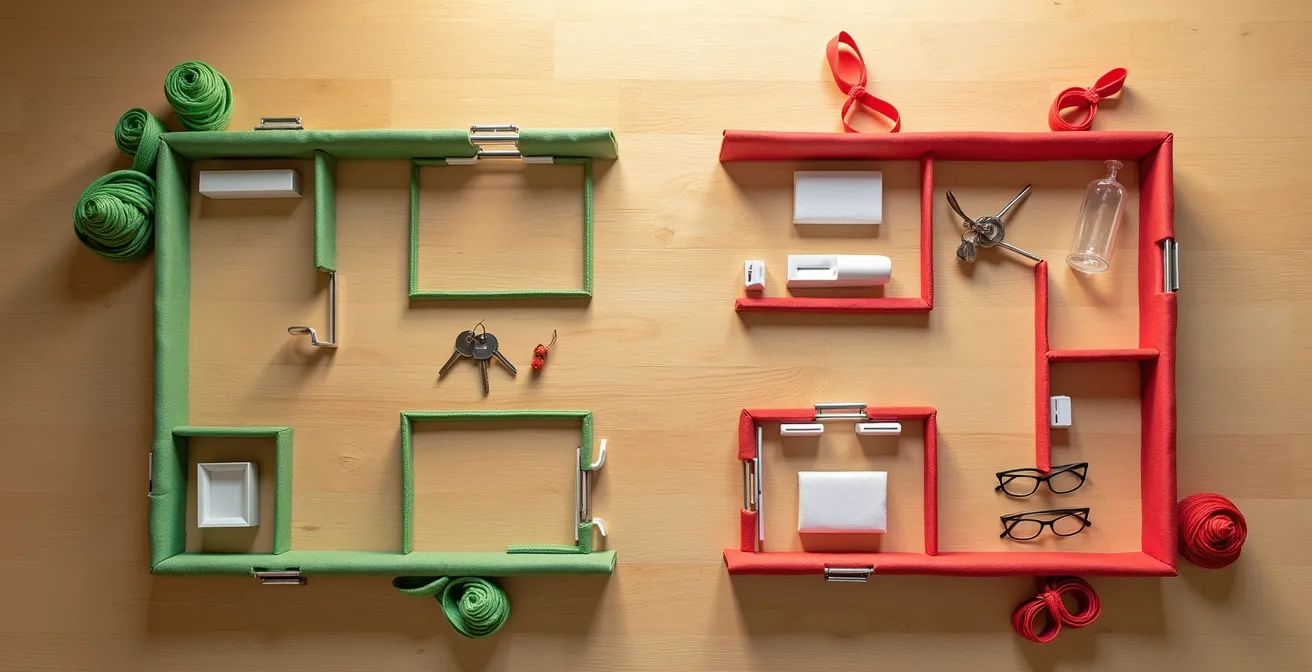
With these boundaries established, you can co-create a checklist. Instead of “Clean the living room,” the task becomes, “Vacuum the open floor areas in the living room, avoiding the bookshelf and the area around the recliner.” This specificity empowers the senior because they have participated in the decision. It shifts the dynamic from you cleaning *their* space to both of you working together to improve *the* space’s safety and function. This collaborative approach is the cornerstone of agency restoration.
Deep Clean Service vs. Maintenance Maid: What Does Your Parent Actually Need?
Families often mistakenly believe that a standard maid service can resolve a situation that is escalating toward hoarding. However, maintenance cleaning and specialized deep cleaning are two fundamentally different services designed for vastly different situations. A maid service is for upkeep in a functional home; a deep clean is a necessary intervention to restore a home to a state of basic safety and sanitation, or what we call a functional baseline.
A maintenance cleaner is tasked with dusting, vacuuming, and sanitizing already accessible surfaces. They are not trained or equipped to handle biohazards, deal with pest infestations, or sort through significant clutter. Asking them to do so is both ineffective and unfair. A specialized deep cleaning or hoarding remediation service, on the other hand, is designed specifically for these challenging environments. As the team at LifeCycle Transitions, a specialized service, notes, their work goes far beyond wiping counters. They perform a crucial function that regular services cannot:
When we do a standard Hoarding Clean Up, our team of Transition Technicians sorts, packs, cleans, hauls away the trash, moves items to storage, launders your items, and then disinfects and sanitizes your home. We provide you with freedom from extreme clutter and harmful airborne toxins in less than two weeks.
– LifeCycle Transitions Team, LifeCycle Transitions Hoarding Cleanup Services
So, how do you decide what your parent needs? The decision rests on an honest assessment of the home’s condition against key safety criteria. The following table, based on a framework from hoarding cleanup specialists, provides a clear guide for this assessment.
| Assessment Criteria | Needs Deep Clean First | Ready for Maintenance Only |
|---|---|---|
| Appliance Accessibility | Key appliances unusable due to clutter | All appliances easily accessible |
| Room Exits | Fewer than two clear exits per room | Multiple clear pathways exist |
| Odor Presence | Persistent odors detected | No unusual odors present |
| Pest Activity | Visible pest activity or droppings | No signs of pests |
| Surface Visibility | Floors/counters covered with items | Most surfaces visible and usable |
| Timeline Needed | 2-3 days intensive work | 2-3 hours weekly sufficient |
If the home falls into the “Needs Deep Clean First” column for even one of these criteria, a maintenance service is not the solution. You must first engage a specialized service to restore safety and sanitation. Only then can a regular maid service be effective in maintaining that new, safer baseline.
The ‘Thrown Away’ Incident: How to Prevent Cleaners from Discarding Valuables?
One of the most traumatic events for a person with hoarding tendencies is the “thrown away” incident—the discovery that a cherished or valuable item has been discarded without their consent. This single event can shatter trust, cause immense emotional distress, and make any future cleaning efforts nearly impossible. It reinforces their fear that the goal of cleaning is to strip them of their possessions. Preventing this incident is paramount and requires a shift from rapid disposal to a methodical, respectful protocol.
The core principle is simple: no item is thrown away without the senior’s explicit permission. This may slow the process, but the preservation of trust is worth more than a quickly cleared room. The key is to establish a clear system for sorting and reviewing items. Nothing should go directly from a pile to a trash bag. Instead, create designated zones: one for obvious trash (with the senior’s agreement), one for donations, one for items to keep, and—most importantly—a “review box” for questionable items.
This “review box” becomes a safe holding area for things that might be valuable or sentimental but are mixed in with clutter. This could include old mail (which might contain uncashed checks), expired documents, or seemingly random objects. A formal photo-documentation process can add another layer of security and trust. A resource guide for caregivers from the Benjamin Rose Institute on Aging suggests a detailed approach. To implement this, you need a clear, actionable plan.
Action Plan: The Photo-Documentation Protocol for Valuables
- Initial Record: Before touching a cluttered area, take a wide-angle “before” photo of the entire space to document its original state.
- Detail Capture: Photograph close-ups of specific areas where valuables might be hidden, such as desktops, drawers, and shelves.
- Safe Sorting: During sorting, place any questionable items into a designated “review box” instead of a trash bag. Never make a unilateral decision to discard.
- Categorical Separation: Create clear, distinct piles for obvious trash (e.g., food wrappers, junk mail) and items that require a decision from the senior.
- Collaborative Review: Schedule a calm, dedicated time to sit with the senior and go through the contents of the “review box” together, item by item.
By adopting this meticulous process, you are not just cleaning a house; you are demonstrating respect and protecting your relationship. This careful method, often used by professional services like specialized senior hoarding cleanup companies, ensures that the focus remains on safety and collaboration, effectively preventing the trauma of a “thrown away” incident.
When to Schedule Seasonal Decluttering to Reduce Fall Risks?
For seniors, a fall can be a life-altering event. The statistics are sobering: according to CDC data, about 25% of adults aged 65 and older fall each year, and falls are the cause of 95% of hip fractures. While many factors contribute to falls, one of the most significant and preventable is a cluttered home environment. Piles of items on the floor, obstructed hallways, and poor access to essentials create a daily obstacle course. Seasonal decluttering, timed strategically, is a powerful tool for proactively reducing these risks.
The goal of seasonal decluttering is not just to tidy up, but to prepare the home for the specific challenges of the upcoming season. The two most critical times for this are late autumn and late spring.
- Late Autumn (October/November): The primary goal here is to prepare for winter, when seniors spend more time indoors and mobility can be further compromised by weather-related issues. This is the time to ensure all safety pathways are clear of clutter, especially hallways and routes to the bathroom and kitchen. It’s also the time to store away summer items and organize winter gear—coats, boots, and extra blankets—in easily accessible locations to prevent them from becoming floor clutter.
- Late Spring (April/May): As the weather improves, this is an opportunity to clear out winter accumulation. It’s the perfect time to sort through closets, check for expired pantry items, and prepare for more activity. Decluttering entryways and windows can also improve natural light, which is crucial for preventing trips and falls.
This image captures the essence of a well-prepared, safe environment. The open entryway, clear of obstacles and bathed in light, is the direct result of proactive, seasonal organization. It represents a space where a senior can move with confidence and safety.
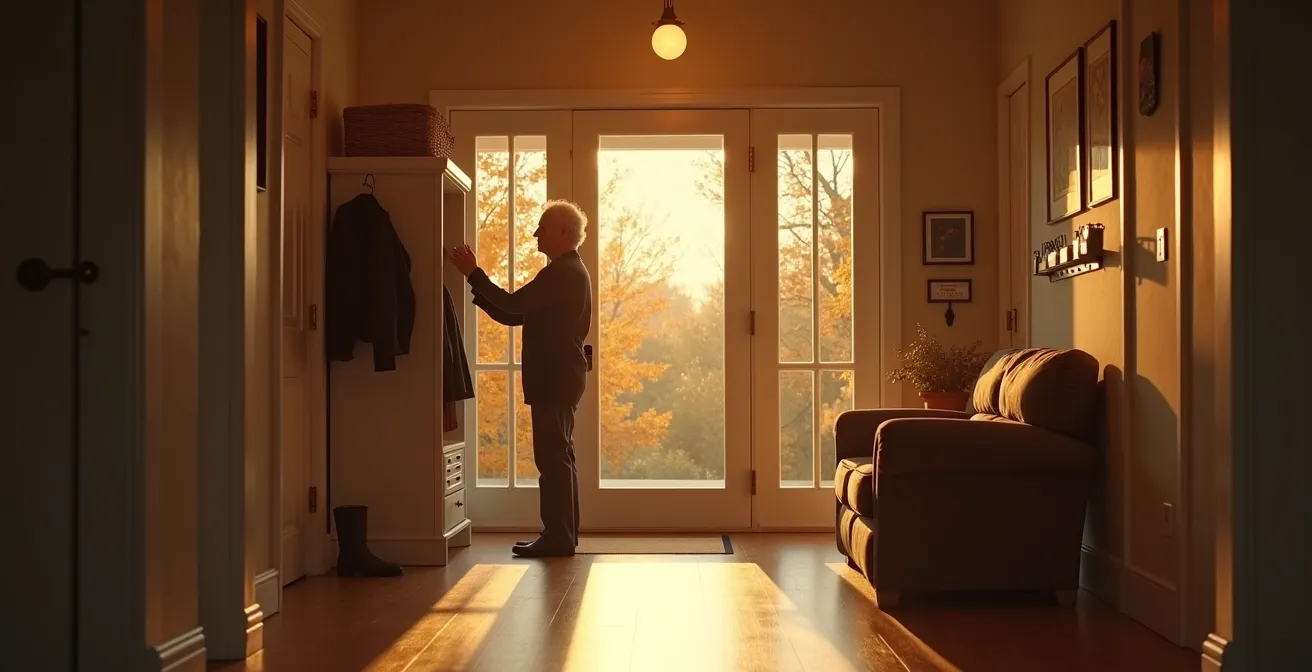
By scheduling these decluttering sessions twice a year, you shift from a reactive, crisis-driven approach to a proactive, preventative one. You are not just cleaning; you are actively engineering a safer environment and significantly lowering the risk of a devastating fall. It becomes a predictable and collaborative ritual, rather than an overwhelming emergency.
Why Thick Area Rugs Are the Number One Trip Hazard for Walkers?
In the quest to make a home cozy and comfortable, families often introduce one of the most dangerous fall hazards for a senior using a walker: the thick area rug. While seemingly harmless, these rugs create an unstable and uneven surface that can easily catch the leg of a walker or the foot of a person with an unsteady gait. The edge of a rug presents a small but significant vertical obstacle that requires a person to lift their feet higher than they may be accustomed to, leading to a trip. For someone with shuffling steps, a common symptom of mobility issues, this is a recipe for disaster.
This is not an anecdotal concern; it is a documented public health issue. A CDC surveillance study published in PubMed analyzed emergency department data and found that an estimated 37,991 adults aged 65 and older are treated annually in the U.S. for falls related to carpets and rugs. The danger is particularly acute at the transition point between a rug and a hard floor, or when a rug bunches or slips. The soft, plush surface that feels luxurious underfoot can cause a walker’s legs to dig in, destabilizing the user and leading to a forward fall.
Further analysis from the CDC revealed that these falls are not random. They frequently occur in specific high-traffic areas, most notably the bathroom, and often happen when a person is hurrying. The combination of a thick rug, a mobility aid like a walker, and a slight sense of urgency creates a perfect storm for a fall. The safest solution is often the most direct: remove all thick, high-pile area rugs and runners from the homes of seniors who use walkers. Instead, opt for low-profile, non-slip mats that are securely taped down, or better yet, bare, slip-resistant flooring. Prioritizing clear, level safety pathways over decoration is a non-negotiable aspect of fall prevention.
The ‘Drawer of Useless Gadgets’ Trap: Buying Tools You Can’t Clean
In homes prone to clutter, there is often a drawer—or a whole cupboard—filled with single-use kitchen gadgets and complex appliances. The air fryer with a dozen attachments, the multi-part juicer, the specialty slicer. These items are often purchased with good intentions but quickly fall into disuse because they are too heavy to lift, too complicated to operate, or, most commonly, too difficult to clean. This accumulation is not just a storage problem; it’s a symptom of a deeper issue.
For some seniors, acquiring new items can be a way to cope with loneliness and feel connected to the world. As one professional organizer explained in an article on AgingCare, the accumulation is often a substitute for social interaction. This compassionate perspective helps reframe the problem from one of “acquiring junk” to one of “seeking connection.”
As we age, many people face a dramatic decline in the quality and frequency of their social interactions. This often leaves seniors feeling lonely and separated from the outside world. Consequently, they may begin to engage in behaviors that seem to help them cope with isolation and depression. In some cases, these behaviors revolve around the accumulation of ‘things’—everything from clothes and knickknacks to food and even living, breathing animals.
– Professional Organizer, AgingCare
To help a parent avoid this trap without creating conflict, the focus should be on establishing practical, objective criteria for any new purchase. Instead of saying “You don’t need that,” you can ask questions based on a simple usability test. Before buying any new gadget, apply this five-point check:
- Disassembly: If it requires more than three steps to take apart for cleaning, it’s too complex and will likely end up unwashed.
- Weight: Can the senior comfortably lift it with one hand to move it to the sink for cleaning? If not, it’s too heavy.
- Maintenance: Does it require special cleaning products, disposable filters, or frequent part replacements? These add hidden complexity.
- Storage: Is there a designated, easily accessible storage spot for it at waist height? If it has to be stored on a high shelf or in a low cabinet, it won’t be used.
- Simplicity: Is there a simpler, non-electric version that accomplishes the same task? Often, a good knife or a simple tool is more practical.
By using this framework, you can gently guide your parent toward more functional choices, preventing the accumulation of hard-to-clean items that ultimately contribute to clutter and sanitation issues. It transforms the conversation from a power struggle into a collaborative problem-solving exercise.
Key Takeaways
- Prioritize Safety Over Aesthetics: The primary goal of cleaning for a senior is to create a safe, functional environment, not a perfectly tidy one. Focus on clear pathways, hazard removal, and sanitation.
- Collaboration is Non-Negotiable: Lasting change comes from working *with* your parent, not doing things *to* them. Use consent-based methods like shared checklists and designated “sacred zones” to build trust.
- Match the Service to the Need: A standard maid service cannot solve a hoarding-level problem. An honest assessment is required to determine if a specialized deep-cleaning or remediation service is necessary first.
How to Improve Indoor Mobility in a Small Apartment Without Major Works?
Improving mobility in a senior’s home doesn’t always require expensive renovations or structural changes. In a small apartment where space is at a premium, some of the most effective interventions are simple, low-cost, and non-invasive. The objective is to create clear, predictable, and well-lit safety pathways that allow a person to move from one essential area to another—from bed to bathroom, from chair to kitchen—with minimal risk.
One of the most powerful tools is strategic furniture arrangement. Often, simply moving a coffee table, pushing a bookshelf against a wall, or removing an unused side chair can open up a critical corridor for a walker or cane. The goal is to create pathways that are at least 36 inches wide. It may mean sacrificing some decorative items for the sake of safety, a trade-off that is always worthwhile. Ensure that there are no electrical cords crossing these paths.
For seniors with cognitive or visual impairments, visual cues can be incredibly effective. As shown in the image below, using high-contrast colored tape on the floor can create a clear, intuitive guide. This simple technique helps define the safe walking zone and can even use arrows to direct a person along the safest route, especially for nighttime trips to the bathroom.

Finally, lighting is crucial. A dimly lit apartment is filled with tripping hazards. Replace low-wattage bulbs with brighter, energy-efficient LEDs. Add motion-activated nightlights along the pathway from the bedroom to the bathroom. Ensure that light switches are easily accessible at the entrance of every room. These small adjustments collectively transform a hazardous space into a secure one, empowering the senior to move about their own home with greater confidence and independence, all without a single nail being hammered.
Taking these steps—from understanding the health risks of dust to implementing respectful cleaning protocols and making simple mobility improvements—is a journey. It requires patience, compassion, and a shift in perspective. The goal is not to achieve a perfect home overnight, but to make consistent, meaningful progress toward a safer and more dignified life for your parent. The first step is always the hardest, but it begins with a conversation, not a confrontation. Assess the situation using the frameworks provided here, and then choose the path that fosters trust and collaboration.