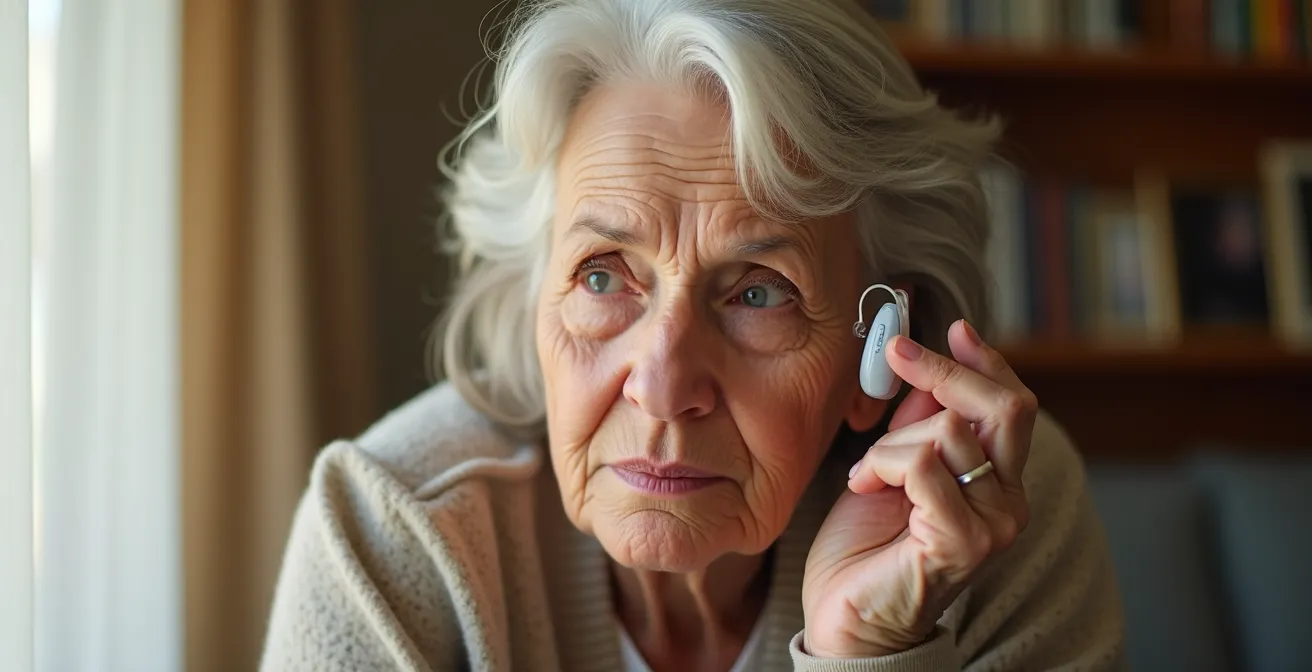
The key to hearing aid adoption isn’t the device’s technology, but a strategic retraining of the user’s brain to handle a renewed world of sound.
- Initial rejection is often due to predictable cognitive overload as the brain struggles with sounds it hasn’t processed in years.
- Success requires a clinical “Graduated Wearing Schedule” and professional fine-tuning that most self-fit OTC devices cannot provide.
Recommendation: Implement a structured wearing plan immediately and schedule a tuning session with an audiologist to adjust the device to the user’s current acclimatization level.
For families, the frustration is palpable: a significant investment has been made in advanced digital hearing aids, only for them to sit unused in a bedside drawer. The common assumption is one of stubbornness or a simple dislike for the device. However, the reality is far more complex and rooted in neuroscience. When a person experiences hearing loss over several years, their brain undergoes a process called auditory deprivation. It literally forgets how to process a full spectrum of sounds, filtering out everything from the hum of a refrigerator to the rustle of leaves as non-essential noise.
When a new hearing aid is introduced, it doesn’t just amplify voices; it reintroduces this entire lost soundscape at once. This sudden influx of information creates an immense cognitive load, leading to exhaustion, irritation, and the feeling that the world is “too loud.” The user isn’t rejecting clear sound; their brain is rejecting a chaotic flood of data it is no longer equipped to handle. The problem isn’t the technology in their ear, but the processing power in their brain.
This article moves beyond simplistic encouragement and provides a technical, problem-solving framework for families and users. We will dissect the neuro-cognitive reasons behind device rejection and outline a clinical path toward successful adoption. By understanding the ‘why’ behind the struggle, you can implement a ‘how’ that actually works, transforming that expensive paperweight back into a life-changing tool. This process involves a structured wearing schedule, understanding the critical difference between device types, and managing the practical daily challenges that lead to abandonment.
This guide will walk you through the essential stages of hearing aid acclimatization, from the initial cognitive challenges to the long-term financial and health considerations. Below is a summary of the key areas we will cover to help you navigate this journey successfully.
Summary: A Clinical Guide to Overcoming Hearing Aid Rejection
- Why New Sounds Exhaust the Brain During the First Month?
- How to Use a ‘Graduated Wearing Schedule’ to Acclimate Successfully?
- OTC Hearing Aids vs. Prescription Devices: Are You Missing Crucial Tuning?
- The ‘Mask Removal’ Risk That Flings Hearing Aids into the Street
- When to Change Batteries to Avoid Outages During Conversations?
- When to Replace Hearing Aids to Maximize Insurance Contribution Cycles?
- Why Seeing Facial Expressions Reduces Communication Anxiety in Seniors?
- Dental, Optical, Audio: Which ‘Enhanced Coverage’ Option is Mathematically Worth It?
Why New Sounds Exhaust the Brain During the First Month?
The primary reason new hearing aid users feel overwhelmed and exhausted is not a flaw in the device, but a biological process of re-adaptation. After years of auditory deprivation, the brain’s auditory cortex has reallocated resources away from processing subtle environmental sounds. When a hearing aid suddenly reintroduces these sounds—the click of a pen, the hum of an air conditioner, footsteps in a hallway—the brain is hit with a tsunami of information it has long since learned to ignore. This creates a significant cognitive load, as the brain must work overtime to sort, identify, and prioritize this new data stream. It’s the neurological equivalent of going from a dark room into bright sunlight; the initial experience is glaring and uncomfortable.
Modern technology is actively working to mitigate this. For instance, research on AI-based noise reduction shows that activating these features leads to reduced oxygen concentration in brain areas tied to effortful listening, indicating more efficient and less strenuous cognitive processing. This shows that the exhaustion is a measurable, physiological phenomenon. Overcoming it isn’t a matter of “toughing it out,” but of systematically allowing the brain’s neuroplasticity to rebuild those atrophied neural pathways.
Case Study: The ACHIEVE Trial and Cognitive Decline
The stakes of this adaptation process are incredibly high, extending beyond just hearing. The landmark ACHIEVE clinical trial provided stark evidence of this connection. In a subgroup of older adults at a higher risk for cognitive issues, consistent hearing aid use resulted in a remarkable 48% slowing of cognitive decline over three years. This finding suggests that successfully acclimatizing to a hearing aid is not just about improving communication; it is a critical intervention for preserving long-term brain health and staving off more severe cognitive impairment.
Therefore, the initial 30 days are a critical period of brain retraining. The goal is not to endure the noise, but to gradually re-teach the brain what is important and what can be filtered out. This requires a deliberate and structured approach, which is the cornerstone of successful, long-term adoption.
How to Use a ‘Graduated Wearing Schedule’ to Acclimate Successfully?
To combat the cognitive overload described previously, the single most effective strategy is implementing a ‘Graduated Wearing Schedule.’ This clinical approach avoids overwhelming the brain by systematically increasing exposure to the new soundscape. Instead of forcing all-day wear from day one—a common cause of failure—the user slowly builds tolerance, allowing their brain to adapt at a manageable pace. This method transforms the process from an endurance test into a structured rehabilitation program. The key is to start in simple, controlled auditory environments and progressively move toward more complex ones.
This paragraph introduces a complex concept. To better understand it, it’s helpful to visualize its main components. The illustration below breaks down this process of documentation and reflection.

As this image suggests, a critical part of this process is self-monitoring. Keeping a simple journal to note when sounds were overwhelming, when conversations were clear, and when fatigue set in provides invaluable data. This information is not just for personal tracking; it is crucial feedback for the audiologist to make precise fine-tuning adjustments at follow-up appointments. A successful acclimatization is a partnership between the user’s disciplined effort and the professional’s technical adjustments.
A typical evidence-based schedule progresses over several weeks. Here is a foundational plan to discuss with an audiologist:
- Week 1: Start with 1-2 hours of daily wear in quiet, familiar environments, like reading at home. The goal is to get used to the sound of one’s own voice and basic household noises.
- Week 2: Increase wear time to 3-4 hours per day. Introduce watching television, initially with captions on as a backup, to help the brain associate the new sounds with visual context.
- Week 3: Extend wear time to 5-6 hours. Begin attempting one-on-one conversations in quiet, controlled settings, focusing on a single sound source.
- Week 4: Target 8 or more hours of wear. Gradually introduce small group settings, like a quiet family dinner, where the brain must start filtering multiple voices.
- Months 2-3: Continue with all-day wear and begin progressive exposure to more challenging environments, such as a moderately busy cafe, while carefully monitoring cognitive fatigue.
OTC Hearing Aids vs. Prescription Devices: Are You Missing Crucial Tuning?
The recent availability of Over-the-Counter (OTC) hearing aids has increased access, but it has also introduced a critical point of confusion for consumers. While both OTC and prescription devices amplify sound, they operate on fundamentally different service models. OTC devices are designed for self-fitting and are intended for perceived mild-to-moderate hearing loss. Prescription devices, conversely, are part of a comprehensive audiological treatment plan that includes professional diagnostics, fitting, and—most importantly—ongoing fine-tuning. This distinction is often the deciding factor between a device that works and one that ends up in a drawer.
As Dr. Cliff Olson, a prominent audiologist, stated in an interview, the best outcomes are tied to professional protocols. This sentiment is key to understanding the value of prescription devices.
Following Best Practices with extreme precision has been proven to consistently provide significantly better treatment outcomes for individuals who wear hearing aids.
– Dr. Cliff Olson, AuD, PRNewswire Interview on Applied Hearing Solutions
The acclimatization process is not static. As the brain adapts, its needs change. An audiologist uses specialized equipment to perform “real-ear measurements,” ensuring the amplification level precisely matches the user’s hearing loss prescription at different frequencies. During follow-up visits, they adjust these settings based on the user’s feedback (“background noise is too sharp,” “voices sound tinny”). This iterative tuning process is impossible with most OTC models, which rely on basic smartphone apps. Without it, the user is stuck with a one-size-fits-all setting that may have caused the initial rejection.
The following table, based on recent market analysis, highlights the core differences between these two categories. It clearly shows that while OTC adoption is growing, it serves a different need than the comprehensive care model of prescription aids.
| Feature | OTC Hearing Aids | Prescription Hearing Aids |
|---|---|---|
| Market Share Growth (2024) | 25% increase in adoption post-FDA ruling | Traditional market maintaining steady growth |
| Price Range | $200-$1,500 per pair | $2,000-$7,000+ per pair |
| Professional Support | Limited or remote only | Ongoing audiologist care included |
| Customization | Self-fitted, app-based adjustments | Real-ear measurements, professional programming |
| Target Hearing Loss | Mild to moderate only | All levels including severe/profound |
The ‘Mask Removal’ Risk That Flings Hearing Aids into the Street
Beyond the complex neuro-cognitive challenges, hearing aid abandonment is often accelerated by simple, practical frustrations. One of the most common—and costly—is the accidental loss of a device. In recent years, a new culprit has emerged: the elastic straps of face masks. When a user removes a mask, the strap can easily catch on a behind-the-ear (BTE) hearing aid, flinging the small, expensive device onto the ground, often unnoticed. This single event can be so frustrating and financially daunting that it leads a user to stop wearing the aids altogether, especially if they fear a repeat incident.
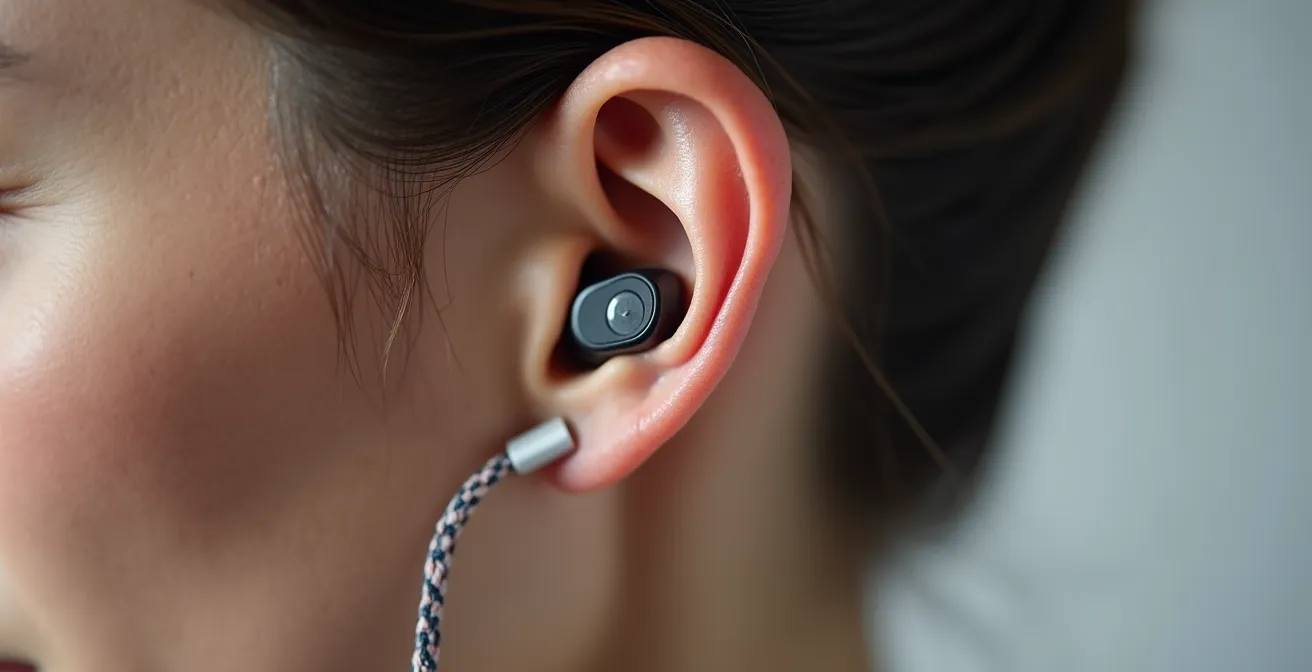
This is not an unsolvable problem. The industry has responded with simple but highly effective engineering solutions designed to secure the device. The most common is a hearing aid retention cord or clip. This is a discreet, thin cord that attaches the hearing aid to the user’s clothing, much like a lanyard for eyeglasses. If the aid is dislodged, it simply dangles safely instead of falling to the ground.
This close-up view shows how a retention system provides a simple, physical safety net against accidental loss.
For a new user already struggling with adaptation, removing these small points of friction is paramount. The fear of losing a device that costs thousands of dollars adds a layer of anxiety to daily use. Investing a few dollars in a retention system provides immense peace of mind and removes a significant psychological barrier to consistent wear. It is a small, practical step that supports the larger goal of making the hearing aid a reliable and stress-free part of daily life, rather than a source of constant worry.
When to Change Batteries to Avoid Outages During Conversations?
A hearing aid that suddenly dies in the middle of a crucial conversation is more than an inconvenience; it’s a breach of trust. For a senior who is tentatively rebuilding their confidence in social situations, an unexpected device failure can be deeply discouraging. It reinforces the idea that the technology is unreliable and can lead them to abandon it altogether. Consistent performance is essential for habit formation. Therefore, a proactive and disciplined battery management protocol is not a minor detail—it’s a core component of successful hearing aid adoption.
Relying on the “low battery” warning is a reactive strategy that guarantees eventual failure at an inopportune moment. A much better approach is to establish a predictable, weekly routine. This removes guesswork and ensures the devices are always powered and ready. Many users find that a “Sunday Night Ritual” of replacing batteries, regardless of their current charge, provides a full week of worry-free use. This turns battery management from a daily unknown into a single, scheduled task.
To prevent outages and build confidence in the device’s reliability, it is vital to move from a reactive to a proactive battery management strategy. The following checklist provides a simple, structured protocol to ensure consistent power and performance.
Your Weekly Battery Management Checklist
- Sunday Night Ritual: Designate one evening per week (e.g., Sunday) to replace the batteries in both hearing aids, regardless of their perceived remaining life.
- Morning Power Check: Before inserting the aids each morning, perform a quick battery check. Most devices have a startup jingle or beep sequence that confirms power status.
- Carry Spares Systematically: Use a small, dedicated pill container or a specialized battery caddy attached to a keychain. Always have at least one fresh pair of batteries on hand when leaving the house.
- Track High-Drain Activities: Make a mental or written note of which activities drain batteries faster. Bluetooth streaming music or phone calls uses significantly more power than quiet listening.
- Establish Emergency Kits: Store a backup package of batteries in key locations where they might be needed, such as in a car’s glove compartment, a desk drawer at an office, or a bag that is used frequently.
By implementing these simple steps, the user (and their family) can eliminate one of the most common and frustrating points of failure. This builds a sense of reliability and trust in the devices, which is fundamental to encouraging their consistent, daily use.
When to Replace Hearing Aids to Maximize Insurance Contribution Cycles?
Managing the financial aspect of hearing aids is a significant concern for families. These devices represent a major investment, and understanding how to leverage insurance benefits is key to long-term affordability and access to the best technology. Most private insurance plans that offer a hearing aid benefit operate on a fixed replacement cycle, typically covering a new set of devices only once every three to five years. Failing to align the purchase of new technology with this cycle can mean forfeiting thousands of dollars in benefits.
It is crucial to contact the insurance provider directly and ask for the specific start and end dates of the current benefit period. This is rarely aligned with the calendar year. Knowing that a benefit cycle ends on, for example, June 30th, allows a family to plan a purchase to maximize that contribution. Waiting until July 1st could mean having to pay fully out-of-pocket and waiting another three to five years for the next eligibility window. This is a costly and easily avoidable administrative error.
This timeline is not arbitrary; it aligns closely with the pace of technological innovation in the audiology field. As industry analysis shows, major hearing aid technological advances occur every 3-5 years. These advancements are not just minor tweaks; they often include significant improvements in areas like AI-driven noise reduction, feedback cancellation, and Bluetooth connectivity. By timing a replacement to coincide with the end of an insurance cycle, users can not only leverage their full benefit but also upgrade to a device with demonstrably superior performance, which can further aid the acclimatization process and improve quality of life.
Therefore, proactive management of the insurance cycle is a critical financial strategy. It ensures that the user has access to the latest technology at the lowest possible out-of-pocket cost, making sustained, long-term use more viable.
Why Seeing Facial Expressions Reduces Communication Anxiety in Seniors?
For a person with hearing loss, even one who is using well-tuned hearing aids, group conversations can be a source of significant anxiety. The cognitive effort required to track multiple speakers, filter out background noise, and process language in real-time can be draining. This is where multimodal communication—the use of more than one sensory input, such as hearing and sight—becomes critically important. Seeing a speaker’s face provides a wealth of information that dramatically reduces the cognitive load on the auditory system alone.
Facial expressions provide emotional context that can be lost in pure audio. Lip movements offer phonetic cues that the brain uses to confirm the sounds it’s hearing, a process known as ‘speechreading’. This visual information helps the brain “fill in the gaps” when a word is missed or garbled, reducing the stress and anxiety of trying to comprehend every single sound. When a new hearing aid user can both see and hear a speaker, their brain has two data streams to work with, making comprehension faster, more accurate, and far less exhausting.
Case Study: The ENHANCE Study and Visual Cues
The importance of visual input is supported by clinical research. The ENHANCE study investigated the role of different communication strategies on cognitive health. The results were telling: participants in the hearing intervention group who were presented with stimuli visually, rather than just auditorily, maintained stable cognitive health over a three-year period. This highlights that leveraging visual cues is a powerful strategy not just for immediate understanding, but for supporting long-term cognitive stability in individuals with hearing loss.
For families supporting a senior, this has a simple, practical application: ensure face-to-face communication whenever possible. In group settings, try to arrange seating so the hearing aid user can easily see everyone who is speaking. Avoid shouting from another room. These small adjustments create a less stressful listening environment, reducing communication anxiety and encouraging the user to remain engaged in social situations rather than withdrawing.
Key Takeaways
- Hearing aid rejection is primarily due to cognitive overload, not stubbornness. The brain requires a structured retraining period.
- A ‘Graduated Wearing Schedule’ is the essential clinical method for successful adaptation, slowly increasing wear time in controlled environments.
- Prescription devices offer crucial, ongoing fine-tuning by an audiologist, a level of customization that self-fit OTC aids cannot match.
Dental, Optical, Audio: Which ‘Enhanced Coverage’ Option is Mathematically Worth It?
When choosing an enhanced insurance plan, many people weigh the benefits for dental, vision, and hearing as roughly equivalent. However, from a long-term health and financial perspective, this is a flawed comparison. The consequences of untreated hearing loss extend far beyond simply missing conversations. The decision to invest in a robust hearing benefit should be weighed not against the cost of glasses or dental work, but against the significant, well-documented costs of cognitive decline, social isolation, and depression.
The scale of the problem is vast and widely underestimated. According to NIDCD statistics, among adults ages 70 and older with hearing loss who could benefit from hearing aids, fewer than one in three (30%) has ever used them. This gap in care has profound implications. As a leading expert from the Alzheimer’s Association has emphasized, the benefits of treatment are holistic.
By combating the social isolation linked to hearing loss, you are also reducing the risk of associated depression and accelerated cognitive decline, which have far greater long-term health costs.
– Dr. Maria C. Carrillo, Ph.D., Alzheimer’s Association International Conference
Mathematically, the calculation becomes clear. The cost of a premium hearing aid, even if it runs several thousand dollars, is a fraction of the potential long-term costs associated with managing dementia or severe depression. Therefore, when evaluating an insurance plan, the hearing benefit often has the highest potential return on investment for overall health and well-being. Prioritizing this coverage is a strategic decision to invest in preserving cognitive function and quality of life, not just in amplifying sound.
Frequently Asked Questions About Digital Hearing Aids
What is my exact hearing aid benefit cycle start and end date?
Contact your insurance provider directly to confirm your specific benefit period, as this varies by plan and may not align with calendar years.
Does my plan differentiate between ‘replacement’ and ‘upgrade’ coverage?
Some plans only cover replacement for loss or damage, while others include technology upgrades as eligible expenses. It’s crucial to clarify this distinction.
What is the maximum benefit amount for in-network vs out-of-network providers?
Benefits can vary significantly. For example, in-network providers may offer 80% coverage while out-of-network might only provide 50% reimbursement, drastically affecting your out-of-pocket cost.
Choosing a plan with a strong hearing aid benefit is an investment in a person’s future cognitive health and independence. It’s a proactive measure with benefits that far outweigh the initial cost of the device or the monthly insurance premium.
To effectively apply these insights, the next logical step is to schedule a follow-up appointment with the user’s audiologist. Use this session to review the device’s current fine-tuning, discuss the challenges noted in the wearing journal, and establish a formal, personalized acclimatization plan.