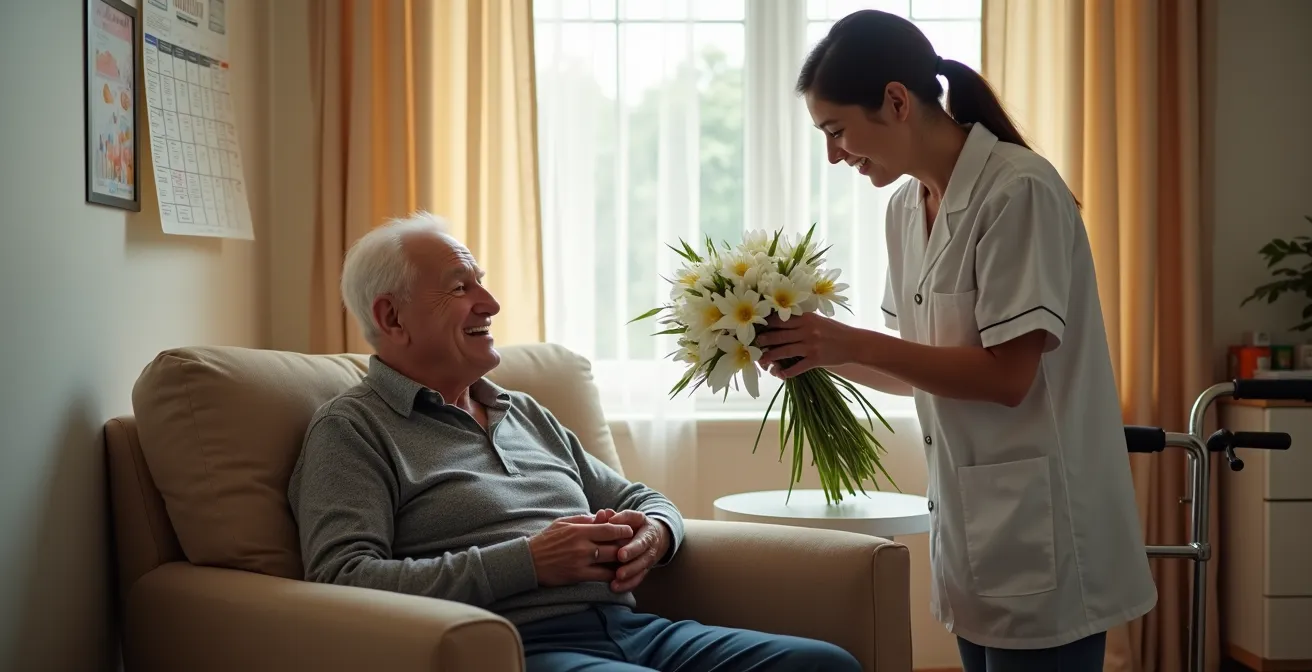
Rebuilding independence after loss isn’t about hiring individual helpers; it’s about architecting a managed ‘Household Operating System’ that supports autonomy and well-being.
- Treat home services as a professional team with clear communication systems and defined roles to eliminate chaos.
- Utilize a hybrid model of agency staff (for reliability) and direct hires (for personal connection) to get the best of both worlds.
Recommendation: Start by appointing a ‘Care Team Captain’—even if it’s yourself—and creating a central communication hub, which can be as simple as a large wall calendar or a shared digital tool.
For a man who has recently lost his wife, the silence of the house is often matched by the overwhelming chaos of managing it alone. The daily rhythm, once a shared and unspoken partnership, is gone. Suddenly, tasks that were seamlessly handled—from meals and laundry to appointments and medications—become a mountain of decisions and duties. This isn’t just about loneliness; it’s a crisis of infrastructure. The person who was the ‘CEO of the Home’ is gone, and stepping into that role while grieving can feel impossible.
The common advice is to get help: hire a cleaner, sign up for a meal service, find a handyman. While well-intentioned, this piecemeal approach often creates more management work, not less. It results in a disconnected series of transactions rather than a cohesive support network. You end up with a revolving door of strangers, conflicting schedules, and the constant stress of coordination. But what if the true key to preserving independence wasn’t just adding more services, but building a better system to manage them?
This guide reframes the challenge. Instead of just “getting help,” you will learn how to design a ‘Household Operating System’—an integrated ecosystem of care that you or a designated family member can manage effectively. It’s about making a strategic shift from being the ‘doer’ of all things to becoming the director of your own well-being. By focusing on structure, communication, and proactive management, you can build a support network that not only preserves independence and dignity but actively enhances mental health and quality of life.
For those who prefer a visual summary, the following video offers a brief overview of key principles for aging in place successfully. It serves as a helpful introduction to the concepts we’ll be exploring in depth.
This article provides a structured roadmap for building that system. We will explore the core components, from the psychological benefits of delegation to the practical tools for coordination and the management principles that ensure your care team is stable and effective.
Summary: Building a Resilient Home Care Ecosystem
- Why Outsourcing Chores Improves Mental Health for Solitary Seniors?
- How to Create a Shared Calendar for Multiple Service Providers?
- Agency Staff vs. Direct Hires: Which Offers More Consistency?
- The Management Mistake That Causes Good Caregivers to Quit
- When to Increase Service Hours Before a Crisis Occurs?
- How to Assemble a Care Team for Dementia Patients Living at Home?
- Single-Story vs. Multi-Level: When Is Moving Inevitable for Safety?
- How to Navigate the Care System for a Parent Over 80 Without Burnout?
Why Outsourcing Chores Improves Mental Health for Solitary Seniors?
For a generation taught the value of self-reliance, the decision to outsource household chores can feel like an admission of defeat. In reality, it is a powerful strategic move to preserve the most valuable resource: mental energy. The burden of managing a household alone isn’t just physical; it’s a significant cognitive and emotional load. Every meal, every bill, every cleaning task represents a decision that must be made and an action that must be taken, contributing to decision fatigue and stress. This constant pressure can be particularly acute for a recent widower navigating a new, solitary life.
The mental health benefits of delegation are profound. By reframing outsourcing as “buying back time and energy,” you transform a perceived weakness into a strength. Removing entire categories of chores—like deep cleaning or complex meal preparation—eliminates a major source of daily anxiety and frees up cognitive space. This allows for a focus on more meaningful activities, such as hobbies, socializing, or physical exercise, which are crucial for combating the isolation that can accompany loss. In fact, research from 2024 indicates that 25% of older people are affected by the kind of social isolation that structured support can help alleviate.
Moreover, a professionally managed home environment reinforces a sense of dignity and control. A clean, organized living space has a direct impact on mood and self-esteem. As the case of Larry, a man who relied on home care after a severe car accident, demonstrates, professional caregivers enabled him to focus on recovery and relearn daily activities while maintaining his dignity at home. Adopting the mindset of a ‘CEO of the Home’—where your primary role is to manage resources, not perform labor—is a crucial shift that supports long-term mental resilience and sustained independence.
How to Create a Shared Calendar for Multiple Service Providers?
Once you’ve embraced delegation, the next challenge is coordination. When you have a housekeeper, a meal delivery service, a companion, and a physical therapist all on different schedules, chaos is inevitable without a central command center. A shared calendar is the non-negotiable backbone of your ‘Household Operating System’. It transforms a collection of independent contractors into a coordinated team, providing clarity for you, your family, and every service provider involved.
The goal is to create a single source of truth that everyone can access. This system should not only display schedules but also house essential information like provider contact details, emergency procedures, and key standing instructions. A simple but effective method is color-coding tasks by purpose: for example, Green for Social (companion visits, family calls), Blue for Medical (doctor’s appointments, therapy), and Orange for Maintenance (housekeeping, repairs). This visual organization allows anyone to understand the day’s or week’s plan at a glance.
This “command center” doesn’t have to be high-tech. The key is choosing a solution that works for both the tech-savvy family members managing logistics and the senior who needs a simple, clear interface.

As the image suggests, a digital photo frame cycling through a simple, color-blocked schedule can be an elegant low-tech interface. For the management side, digital tools offer real-time updates and communication features that a physical binder cannot match. The choice depends entirely on the complexity of the schedule and the comfort level of the users.
This table offers a clear comparison to help you decide on the right tool for your specific situation.
| Feature | Digital Solutions (Trello, Google Calendar) | Physical Solutions (Wall Calendar, Binder) |
|---|---|---|
| Accessibility for Senior | Requires basic tech skills; can sync to digital frames | No technology needed; always visible |
| Multi-Provider Access | Real-time updates for all providers | Requires manual copying/communication |
| Communication Features | Built-in messaging, alerts, notes | Written notes only |
| Cost | Free to $10/month | One-time purchase ($20-50) |
| Best For | Tech-comfortable families with 3+ providers | Simple schedules with 1-2 providers |
Agency Staff vs. Direct Hires: Which Offers More Consistency?
Building your care team involves a critical decision: do you hire caregivers through an agency or employ them directly? Each path has distinct implications for consistency, cost, and your level of management responsibility. The “best” choice is rarely one or the other, but often a strategic combination of both. An agency’s primary advantage is reliability. They handle vetting, background checks, insurance, and payroll. Most importantly, if a scheduled caregiver is sick or unavailable, the agency is responsible for sending a qualified replacement, ensuring there are no gaps in essential care like medication reminders or personal assistance.
The downside of agencies can be a lack of personal consistency. You may experience a rotation of different caregivers, which can be unsettling and disrupt the personal rapport that is so vital to quality care. This is where direct hires shine. By hiring someone directly, you have complete control over who enters the home, allowing you to choose a caregiver based on personality, shared interests, and a true sense of connection. This can foster a deep, trusting relationship that significantly improves quality of life. However, with a direct hire, you become the employer, responsible for taxes, insurance, and creating your own backup plan for sick days or vacations.
For many, a hybrid model offers the ideal balance. Use a licensed agency for critical, non-negotiable tasks that require guaranteed coverage—such as morning routines, medication management, and meal preparation. Then, supplement this with a carefully vetted direct hire for companionship, errands, and social outings. This approach gives you the consistency of a personal relationship alongside the reliability of an agency’s logistical safety net. One family successfully used an agency for daily tasks while a direct-hire companion provided 10 hours of social engagement weekly, resulting in 18 months of consistent care with zero coverage gaps.
The Management Mistake That Causes Good Caregivers to Quit
Once you’ve assembled a care team, the biggest threat to stability isn’t a lack of funds or a difficult schedule—it’s poor management. The single most common mistake that causes excellent caregivers to leave is failing to treat them as valued, professional members of a team. This often manifests as “scope creep”—when a role initially defined as companionship slowly morphs to include heavy housekeeping, nursing tasks, or being on call 24/7. Without a clear scope of work and professional respect, even the most dedicated caregiver will burn out and seek a better-managed environment.
Treating caregivers as professionals means establishing clear boundaries, communication channels, and feedback loops. A written ‘Scope of Work’ document is not a sign of mistrust; it is a tool of professional respect that protects both parties. Regular, brief “team huddles”—even just five minutes at the start of a shift—create a formal opportunity to gather their invaluable insights. As one expert puts it, the failure is in not actively soliciting their input. This is highlighted by Yelena Sokolsky, RN, in the Galaxy Home Care Professional Guidelines:
Caregivers are often the ‘eyes and ears’ in the home. The mistake is not actively soliciting their insights and observations about the senior’s well-being.
– Yelena Sokolsky, RN, Galaxy Home Care Professional Guidelines
This simple act of listening transforms a caregiver from a task-doer into a strategic partner in care. It acknowledges their expertise and the emotional labor involved in their work. Consistently asking “How are you holding up?” and genuinely listening to the answer can be as important as prompt payment. Ultimately, retaining good people requires creating an environment of mutual respect, clear expectations, and open communication.
Your Checklist for Retaining Great Caregivers
- Create a written ‘Scope of Work’ document and review it quarterly to prevent mission creep and clarify expectations.
- Hold weekly 5-minute ‘team huddles’ to formally gather caregiver insights and observations about the senior’s condition.
- Acknowledge emotional labor by regularly asking “How are you?” and actively listening to the response.
- Maintain a consistent schedule and provide at least 48-hour notice for any necessary changes, respecting their time.
- Ensure prompt and reliable payment, treating them as the professionals they are.
When to Increase Service Hours Before a Crisis Occurs?
The most effective care plans are proactive, not reactive. Waiting for a fall, a medication error, or a significant decline in health to adjust the level of support is a recipe for crisis management. The key to maintaining stability is to identify the subtle, leading indicators that suggest needs are increasing. These are often small changes in routine and behavior that, when viewed together, paint a clear picture of growing vulnerability. The goal is to increase service hours or add a new type of support before a small problem becomes an emergency.
Monitoring these indicators requires a system of observation. Caregivers, family, and the senior himself should be aware of what to look for. One of the first signs of a breakdown in routine is often found in the kitchen. Is fresh food spoiling in the refrigerator? Are trash cans and recycling bins staying empty, suggesting meals are being skipped? Another key area is the mail. A pile of unopened letters can be a red flag for cognitive decline or a loss of ability to manage daily affairs. Similarly, a gradual increase in clutter, a decline in personal grooming, or a noticeable drop in the frequency of social calls are all important data points.
Documenting these observations is crucial. A simple logbook or a shared digital note where caregivers can jot down observations (“Noticed Mr. Smith seemed unsteady this morning,” or “Trash wasn’t taken out this week”) creates a running record. When you start noticing a pattern of these “near-misses” or minor incidents, it is the signal to act. This is the time to convene a team meeting and discuss increasing service hours, perhaps from three days a week to five, or adding a weekend check-in. Acting on these leading indicators is the essence of preventative care and the surest way to extend independence safely at home.
How to Assemble a Care Team for Dementia Patients Living at Home?
When a diagnosis of dementia enters the picture, the ‘Household Operating System’ must evolve to a higher level of structure and expertise. The stakes are higher, and the need for a truly integrated team is paramount. Assembling this team is not just about filling roles; it’s about creating a web of support with clear communication protocols and a unified strategy. Unfortunately, many families struggle to get the right help, as SAMHSA data from 2024 shows that only 46% of older adults with a mental illness (which includes dementia) received any form of treatment.
A comprehensive dementia care team extends beyond the primary caregiver. It should ideally include a geriatric physician, a neurologist, a social worker or case manager, and potentially physical or occupational therapists. However, the most critical role, and the one most often missing, is the ‘Care Team Captain.’ This person is the central hub, responsible for coordinating information, preventing conflicting advice, and ensuring everyone is working from the same playbook. This role is essential for navigating the complexities of the condition, as highlighted by Dr. Richard G. Frank’s research.
The team needs a ‘Care Team Captain’ to prevent conflicting advice from different professionals and family members from confusing the patient.
– Dr. Richard G. Frank, Brookings Institution Mental Health Research
The Captain—often an adult child, a spouse, or a hired geriatric care manager—manages the shared calendar, facilitates team communication, and serves as the primary point of contact. Their job is to synthesize information from all providers and present a clear, consistent plan. For a person with dementia, who thrives on routine and predictability, this consistency is not a luxury; it is a clinical necessity. It reduces confusion and anxiety, making it possible to manage the condition at home for longer.
Key takeaways
- Shifting from ‘doing’ to ‘managing’ is the key to preserving a widower’s mental health and autonomy.
- A centralized communication system (like a shared calendar) is the non-negotiable backbone of any multi-provider care plan.
- The best care teams often use a hybrid model, combining agency reliability for essential tasks with direct hires for personalized companionship.
Single-Story vs. Multi-Level: When Is Moving Inevitable for Safety?
The desire to age in place is nearly universal; as of 2025, research confirms that 77% of Americans over age 50 prefer to remain in their own homes. For many, the biggest physical barrier to this goal is stairs. In a multi-level home, stairs can become a daily hazard, increasing the risk of falls and isolating an individual to a single floor. This often leads families to believe that moving to a single-story home or an assisted living facility is inevitable. However, before making such a life-altering and expensive decision, it’s crucial to explore the concept of ‘zone living’.
Zone living is a strategy that adapts a multi-level home for single-level living. It involves modifying the ground floor to contain all essential living spaces: a bedroom, a fully accessible bathroom, a kitchen, and a living area. This approach can be far more cost-effective than moving and allows the person to remain in their familiar environment. While not every home is a candidate, many are, and a startlingly low number—only 10% of American homes—are currently ‘aging ready’, highlighting the need for proactive modification.
Case Study: The $18,000 Modification That Saved a Move
An 82-year-old widower in suburban Dallas was facing a move to a $250,000+ assisted living apartment because he could no longer safely navigate the stairs in his two-story home. Instead, he invested $18,000 to convert his ground-floor formal dining room into a primary bedroom and installed a new walk-in shower in the adjacent powder room. This created a complete, safe, and independent living ‘zone’ on one level. Three years later, he remains in his home, feeling safer and more independent, while the upstairs remains available for visiting family. The modification effectively eliminated the primary safety risk and postponed a costly move indefinitely.
This strategy makes moving a last resort rather than a first response. The decision to move should only be considered ‘inevitable’ after a thorough assessment by an occupational therapist and a certified aging-in-place specialist (CAPS) has determined that the home cannot be safely and cost-effectively modified. For many, creating a functional, safe zone on a single floor is the key to unlocking many more years of independence in the home they love.
How to Navigate the Care System for a Parent Over 80 Without Burnout?
Building and managing this entire ‘Household Operating System’ is a significant undertaking. For an adult child trying to support a widowed parent, or for the widower himself, the process of vetting providers, creating schedules, and managing a team can quickly become a full-time job, leading to burnout. This is where the ultimate ‘CEO of the Home’ move comes into play: outsourcing the outsourcing. Just as you delegate cleaning or cooking, you can delegate the very management of the care system itself by hiring an Aging Life Care Professional, also known as a geriatric care manager.
These professionals are the ‘general contractors’ of elder care. They are typically social workers or nurses with deep expertise in navigating the complex and fragmented landscape of senior services. They can conduct a comprehensive assessment, create a detailed care plan, vet and hire local service providers, and establish the very systems of communication and oversight discussed in this guide. While their services represent an upfront cost, the return on investment in time saved, stress reduced, and crises averted is often immeasurable.
Case Study: The $2,500 Consultation That Saved 15+ Hours a Week
A daughter, overwhelmed with caring for her 85-year-old widowed father, hired an Aging Life Care Professional for a one-time $2,500 consultation. The care manager conducted a full needs assessment, created a comprehensive care plan, vetted and presented three qualified local home care agencies, and set up a shared digital calendar and communication protocol. This single intervention saved the daughter an estimated 15+ hours per week of research and administrative work. The investment paid for itself within two months through better service negotiations and, most importantly, prevented her from burning out.
Engaging a professional doesn’t mean abdicating responsibility; it means leveraging expert guidance to build the most effective and sustainable system possible. Whether you manage the system yourself, share the role of ‘Care Team Captain’ with a sibling, or hire a professional to build and oversee it, the principle remains the same. A structured, well-managed system is the most powerful tool for preserving dignity, promoting well-being, and enabling a widower to live independently and safely in the place he calls home.
To transform this advice into action, the next logical step is to perform a simple needs assessment and begin drafting your own ‘Household Operating System’. For complex situations, engaging an Aging Life Care Professional can provide the expert blueprint needed to ensure safety and independence.