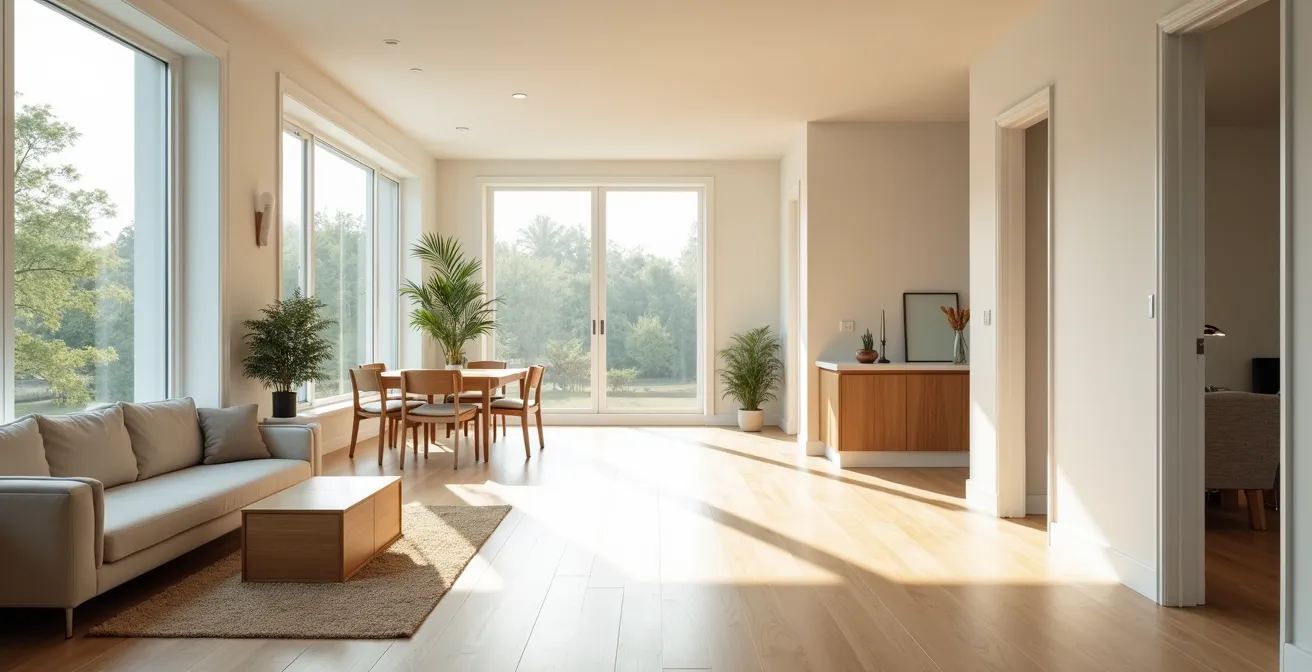
Achieving true ground-floor accessibility is not about isolated fixes, but designing a holistic system where every dimension and surface works in concert to ensure seamless mobility.
- Doorways must provide a minimum of 32 inches of clear width, with 36 inches being the functional ideal for power wheelchairs.
- Floor transitions must be under ½ inch, and surfaces must have a low friction coefficient to reduce user fatigue and prevent snags.
- A minimum 60-inch diameter turning circle is a non-negotiable requirement for functional room layouts.
Recommendation: Audit your space not for individual obstacles, but for “tolerance stacking,” where multiple small barriers combine to create a total blockage in the home’s traffic flow.
Adapting a ground floor for a family member who uses a wheelchair often begins with a series of seemingly straightforward tasks: widening a door, removing a rug, adding a ramp. While these individual modifications are necessary, they often fail to create a truly functional, barrier-free environment. The reason for this failure lies in a common misunderstanding of accessibility. It is not a checklist of items to be ticked off, but a holistic system of interconnected spatial tolerances. A single half-inch threshold, a doorway that is technically wide enough but lacks approach clearance, or a plush carpet can break the entire system, rendering other expensive modifications useless.
The core issue is often “tolerance stacking,” a technical concept where multiple, seemingly minor obstacles accumulate to create an impassable barrier. A wheelchair user might manage a single tight turn, but a tight turn followed immediately by a high-friction surface and then a slight incline becomes a point of total failure. This guide moves beyond the generic advice. As an accessibility consultant, the focus here is on the technical specifications and the physics of movement—the “why” behind the “what.” We will analyze the critical dimensions, friction coefficients, and clearance envelopes required to create genuine flow dynamics, transforming a series of rooms into a single, cohesive, and navigable space for any mobility device.
This article will deconstruct the ground floor into its critical components, providing the specific metrics needed to audit and design a space for seamless flow. We will cover the precise clearance required for different types of wheelchairs, the technical differences in flooring that impact mobility, and the layout principles that prevent creating unintentional traps. By focusing on these technical details, you can ensure your home adaptation investment results in true independence and safety, not just a collection of disconnected fixes.
This guide provides a detailed breakdown of the critical adjustments needed to ensure full accessibility. The following sections will walk you through the technical requirements for every aspect of your ground floor, from door widths to furniture placement, ensuring a comprehensive and effective home modification.
Summary: A Technical Blueprint for Ground-Floor Accessibility
- Why Standard 30-Inch Doors Block Access for Power Wheelchairs?
- How to Level Uneven Flooring Between Rooms Without Major Structural Work?
- Carpet vs. Hardwood: Which Surface Reduces Drag for Walkers and Wheelchairs?
- The Furniture Layout Mistake That Traps Seniors in Their Own Living Room
- When to Install a Platform Lift Instead of a Ramp for High Porches?
- Why Widening Hallways Is the Only Solution for Power Wheelchair Access?
- Why Thick Area Rugs Are the Number One Trip Hazard for Walkers?
- How to Improve Indoor Mobility in a Small Apartment Without Major Works?
Why Standard 30-Inch Doors Block Access for Power Wheelchairs?
A standard 30-inch interior door provides approximately 28.5 inches of usable passage when open, a dimension that is fundamentally insufficient for most wheelchairs, especially powered models. The critical metric is the “clear width,” which is the unobstructed space available for passage. According to ADA standards, the absolute minimum clear width for a doorway is 32 inches to be considered accessible. However, this is a bare minimum that doesn’t account for the user’s hands on the wheels of a manual chair or the wider base of many power wheelchairs. For functional, comfortable access, a 36-inch doorway is the recommended standard.
The problem is not just the width of the chair itself but the “clearance envelope” required for maneuvering. Approaching a door at a slight angle, turning, or simply propelling a manual chair requires extra space for hands and elbows. A 32-inch clearance leaves no room for error and can lead to scraped knuckles and damaged door frames. For families adapting a home, achieving at least a 34-inch, and ideally a 36-inch, clear opening for main pathways is a primary objective. As accessibility consultant Julie Sawchuk discovered when building her own home, 36-inch wide doorways are ideal for main rooms, and this practical experience underscores the gap between minimal compliance and genuine livability.
Fortunately, widening a doorway doesn’t always require major structural work. Several technical solutions can be implemented. The simplest is installing offset or “Z” hinges, which are designed to swing the door completely clear of the frame, adding up to an inch of precious clearance. If more space is needed, removing the door and its stop molding can be an effective, low-cost option, with a curtain used for privacy. For a marginal gain without removing the door, the decorative door trim can sometimes be removed. Only when these options are insufficient should widening the frame itself be considered.
How to Level Uneven Flooring Between Rooms Without Major Structural Work?
Uneven transitions between rooms are a primary cause of mobility failure within a home. A seemingly insignificant height difference can halt a wheelchair or create a serious trip hazard for someone using a walker. The concept of “threshold gradient” is critical; even a small, abrupt vertical change is more difficult to navigate than a slightly longer, gradual slope. The ADA standards specify that any vertical change over ¼ inch must be beveled, and the maximum threshold height is ½ inch to maintain accessibility. Anything exceeding this height is considered a barrier and must be addressed with a ramp or other solution.
For homes with varying floor materials, such as tile in a bathroom meeting hardwood in a hallway, these threshold barriers are common. The goal is to create a flush, smooth surface that eliminates any potential for snagging or tipping. Before considering major structural work like leveling subfloors, several non-invasive technical solutions can effectively resolve these issues. The most common and effective solution for small height differences (up to 1-2 inches) is the installation of rubber or aluminum threshold ramps. These are specifically designed to provide a durable, slip-resistant, and correctly graded transition over doorsteps and floor level changes.
For a completely seamless transition, the ideal solution is to remove the doorsteps and thresholds entirely. This creates a perfectly flat path, allowing motorized wheelchairs and walkers to pass through without any obstacle. If a threshold must remain for reasons related to flooring termination, it must be a low-profile, beveled design. For any height difference greater than ½ inch that cannot be resolved with a simple threshold ramp, a more substantial portable or permanent ramp must be installed, strictly following ADA guidelines for slope and length. The objective is always to minimize the tolerance stacking of obstacles; removing a threshold barrier is often one of the most impactful changes for improving indoor mobility.
Carpet vs. Hardwood: Which Surface Reduces Drag for Walkers and Wheelchairs?
The choice of flooring material has a direct and significant impact on mobility, safety, and user fatigue. The key technical parameter is the friction coefficient, or drag, of the surface. A high-friction surface, like a medium-pile carpet, requires substantially more force to propel a manual wheelchair and can drain the battery of a power chair more quickly. For individuals with limited upper body strength or stamina, this added resistance can severely limit their independence within the home. Hard, smooth surfaces offer the lowest friction and are therefore the superior choice for accessible design.
The ideal flooring materials are those that are durable, smooth, and non-slip. Hardwood and laminate flooring are excellent choices as they provide a very smooth rolling surface that is also extremely durable. Ceramic tiles are also a good option, particularly in kitchens and bathrooms, due to their water resistance and ease of maintenance, though grout lines should be minimal and flush to prevent jarring. If carpet is desired for its acoustic or thermal properties, it is imperative to select a low-pile, high-density commercial-grade carpet with a pile height of less than ¼ inch. This type of carpet provides a much firmer surface and significantly reduces drag compared to plush residential carpeting.
This visual comparison highlights the fundamental difference in surface texture. The smooth, uninterrupted grain of the hardwood provides a low-friction path, while the woven fibers of the carpet, even when low-pile, introduce a level of resistance that must be overcome with every push or motor rotation.
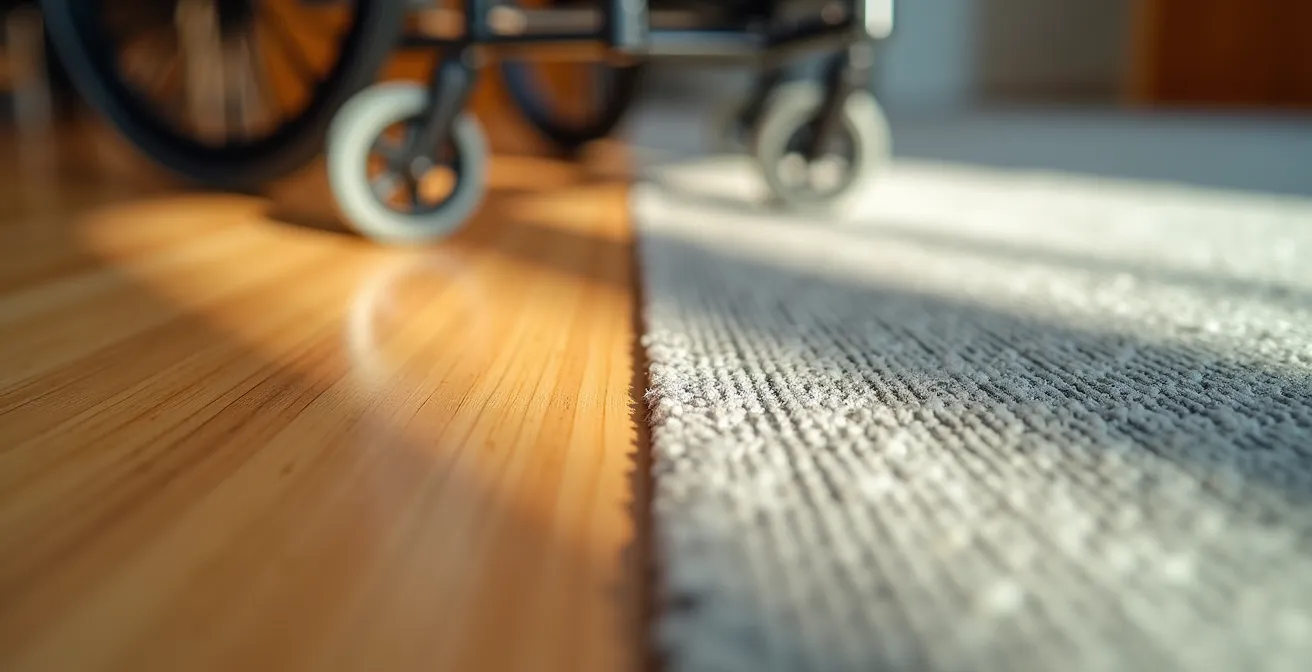
As the image demonstrates, the physical interaction between the wheel and the floor is critical. A smooth surface promotes efficient “flow dynamics,” allowing for continuous movement with minimal effort. In contrast, a textured surface creates constant micro-resistance, contributing to the “tolerance stacking” effect that increases fatigue and reduces overall mobility throughout the day. The following table provides a clear comparison of common flooring options from a technical accessibility standpoint.
| Flooring Type | Wheelchair Suitability | Key Benefits | Maintenance |
|---|---|---|---|
| Hardwood | Excellent | Extremely durable, smooth rolling surface | Moderate |
| Laminate | Excellent | Durable, scratches removed easily, affordable | Easy |
| Ceramic Tiles | Good | Water resistant, ideal for kitchens/bathrooms | Easy |
| Low-pile Carpet | Moderate | Best carpet option if needed, reduces noise | Regular cleaning needed |
The Furniture Layout Mistake That Traps Seniors in Their Own Living Room
The most common and debilitating mistake in accessible interior design is creating a layout that ignores the “clearance envelope” required for wheelchair maneuverability. Placing furniture in a way that creates narrow pathways or dead ends can effectively trap a person in their own room. The critical metric for any functional space is the turning circle. To execute a 360-degree turn without a series of difficult multi-point turns, wheelchairs require approximately a 5-foot (60-inch) diameter turning space. Failing to provide this open area in primary living spaces like the living room, kitchen, and bedroom is a fundamental design flaw.
This 60-inch clearance is not a luxury; it is a technical requirement for functional independence. It allows the user to change direction, approach furniture or doorways from the correct angle, and recover from a wrong turn without assistance. As accessibility expert Karen Braitmayer notes, this is the best practice for room design:
Best practice is to have a space that is 60 inches in diameter clear in a room. Minimum usability is a space that is 30 inches by 48 inches, the footprint of a standard adult wheelchair.
– Karen Braitmayer, Care.com Resources – Wheelchair Accessible Home Tips
A layout that only provides linear paths without adequate turning nodes forces a “stop-and-go” pattern of movement, which is inefficient and frustrating. The goal should be to create a layout that promotes continuous “flow dynamics.” This often means adopting an open-plan concept where possible, removing non-essential furniture, and selecting pieces with a smaller footprint. For example, replacing a large central coffee table with smaller C-shaped end tables that can slide over the arm of a sofa clears the central floor space and removes a major obstacle. This principle is demonstrated in the McBride family’s accessible home, where an open-plan design not only provided wheelchair access but also enhanced family life by creating a fluid, interconnected space.
When to Install a Platform Lift Instead of a Ramp for High Porches?
For overcoming significant vertical changes at a home’s entrance, such as a high porch or a series of steps, a ramp is often the first solution considered. However, a ramp is not always the most practical or safest option. The decision to install a ramp versus a vertical platform lift (VPL) is a technical one, governed by space, safety, and user capability. The primary constraining factor is the required slope. To be safe and usable, ADA standards require ramps to follow a 1:12 ratio. This means for every 1 inch of vertical rise, 12 inches (1 foot) of ramp length is required.
This ratio is non-negotiable for safety. A steeper ramp is difficult and dangerous to ascend in a manual wheelchair and can cause a power chair to tip. A porch that is 24 inches high would therefore require a ramp that is at least 24 feet long. Furthermore, any ramp longer than 30 feet must incorporate a flat, 5×5 foot resting platform, further increasing the spatial footprint. If the available space at the front of the house cannot accommodate a ramp of this length without creating awkward switchbacks or encroaching on property lines, a VPL becomes the superior technical solution.
A VPL, often called a “porch lift,” moves vertically and has a much smaller footprint than a long ramp. It is often a safer option in climates with ice and snow, where a long ramp can become treacherous. While the initial cost of a VPL is typically higher, it can be a better long-term investment for aging in place, as it requires no physical exertion from the user or a caregiver. The following checklist provides a systematic process for making this critical decision.
Your Action Plan: Choosing Between a Ramp and a Vertical Lift
- Calculate Required Ramp Length: Measure the total vertical rise from the ground to the porch surface in inches. Multiply this number by 12 to determine the minimum required ramp length in inches.
- Assess Available Space: Measure the linear space available in your yard. If the required ramp length exceeds the available space or is longer than 360 inches (30 feet), a lift is likely the better technical choice.
- Evaluate Safety and User Factors: Consider the physical strength of the user and any caregivers. Pushing a wheelchair up a long ramp can be strenuous. Also, assess weather conditions; a VPL is unaffected by ice or snow.
- Consult a Professional: If a ramp would be too long, too steep, or unsafe, contact a certified accessibility contractor to evaluate options for a vertical platform lift or, in some cases, an enclosed elevator.
- Factor in Long-Term Needs: A VPL provides greater independence and is more adaptable to changing mobility needs over time, making it a strategic investment for aging in place despite a higher initial cost.
Why Widening Hallways Is the Only Solution for Power Wheelchair Access?
While creative furniture arrangements can free up space within a room, there is no substitute for adequate width in a hallway. Hallways are the primary arteries of a home’s traffic flow, and if they are too narrow, the entire ground floor becomes a series of disconnected islands. The absolute minimum width for a hallway to be considered accessible is 36 inches, following ADA recommendations. However, this dimension is a straight-line measurement and does not account for turning or the wider footprint of many power wheelchairs.
A 36-inch hallway provides just enough space for forward movement but leaves no margin for error. For a power wheelchair user, or anyone needing to make a turn into a doorway off the hall, this width is often insufficient. To make a 90-degree turn from a 36-inch hallway into a doorway, the doorway itself must be significantly wider than 32 inches to accommodate the turning radius. A more functional and safer standard for a main hallway is 42 to 48 inches. This width provides a comfortable “clearance envelope,” allowing for easy passage, turning into rooms, and passing another person.
Unlike rooms, hallways cannot be made wider with clever furniture placement. If a structural wall defines the space, widening the hallway is a significant construction project. However, it is often the single most transformative modification for whole-home accessibility. It directly improves the “flow dynamics” of the house, reducing the need for difficult, multi-point turns and creating a feeling of openness and independence. The psychological benefit of navigating a spacious, well-lit hallway cannot be overstated, as it replaces a sense of confinement with confidence and ease of movement.

As this image conveys, an adequately wide hallway provides more than just physical passage; it provides a sense of freedom. When planning a home modification, the cost of widening a critical hallway should be weighed against the profound, daily impact it will have on the user’s quality of life. It is a foundational element of a truly accessible system.
Why Thick Area Rugs Are the Number One Trip Hazard for Walkers?
Area rugs, especially those with a thick pile or unsecured edges, are the single most dangerous and common obstacle in a home for people with mobility challenges. For a person using a walker, the edge of a rug can easily catch a foot, leading to a fall. For a wheelchair user, a plush rug is like driving through sand; the high friction coefficient dramatically increases the effort required for propulsion. Furthermore, the curled edges or bunched fabric of a throw rug can completely stop a wheelchair, creating a tipping hazard.
From a technical standpoint, the ideal solution is to remove all area and throw rugs from high-traffic areas. As accessibility expert Karen Braitmayer states, the principle is simple and absolute:
All hard surface flooring is better than area rugs or deeply padded carpets.
– Karen Braitmayer, Accessibility Expert, Care.com Resources
This is because hard surfaces provide a consistent, low-friction plane for movement. However, if rugs are considered essential for decoration or comfort, strict safety protocols must be followed. Any rug must be an ultra-low pile variety, with a height of no more than ¼ inch. Most importantly, all four edges and corners must be securely fastened to the floor using heavy-duty, double-sided carpet tape or a full-coverage non-slip backing to eliminate any possibility of a curled edge. Placing a rug on top of an already carpeted floor should be avoided at all costs, as this creates an unstable and hazardous surface.
For those who want decorative elements without the physical barrier, there are excellent zero-height alternatives. Painted floor designs or stencils can create the visual effect of a rug without any physical obstruction. Another increasingly popular option is the use of vinyl floorcloths. These are durable, non-slip, and completely flat, offering intricate patterns and colors while maintaining a perfectly smooth surface for walkers and wheelchairs. They provide the aesthetic benefit of a rug with the superior technical performance of a hard floor.
Key Takeaways
- True accessibility requires a systemic approach, focusing on the flow between spaces, not just isolated fixes.
- Minimum clearances are a starting point; functional design for power wheelchairs often requires exceeding ADA minimums (e.g., 36″ doors, 42″+ hallways).
- Every vertical transition, no matter how small, is a potential barrier that must be eliminated or mitigated with a correctly graded ramp or lift.
How to Improve Indoor Mobility in a Small Apartment Without Major Works?
Achieving accessibility in a smaller living space like an apartment presents a unique challenge, as major structural changes like widening hallways are often not feasible. The strategy must therefore shift from construction to optimization, focusing on maximizing every square foot of available space and leveraging technology. The core principle is to improve “flow dynamics” by removing all non-essential obstructions and selecting multi-functional or space-saving furniture.
The first step is a radical re-evaluation of the furniture layout. The goal is to create a clear, circular traffic path that eliminates dead ends. This might involve replacing a traditional dining set with a rectangular table placed against a wall, freeing up the central area. Replacing bulky, floor-standing furniture with wall-mounted alternatives is one of the most effective strategies. For example, a wall-mounted TV eliminates the need for a large media console, and wall-mounted shelves or floating nightstands free up critical floor space that can be used for a wheelchair’s turning circle. The following table illustrates the potential space savings from these smart substitutions.
| Traditional Furniture | Accessible Alternative | Space Saved | Benefit |
|---|---|---|---|
| Coffee Table | C-shaped End Tables | 4-6 sq ft | Can slide over sofa arm, no floor obstruction |
| Floor Bookcase | Wall-mounted Shelves | 3-4 sq ft | Completely frees floor space |
| TV Stand | Wall-mounted TV | 4-6 sq ft | Eliminates furniture barrier |
| Nightstand | Floating Nightstand | 2-3 sq ft | Wheelchair can roll underneath |
Beyond furniture, smart home technology offers a powerful way to reduce the need for physical movement within a tight space. As one case study on accessible technology highlights, voice-controlled automation for lights, thermostats, and security systems can eliminate dozens of small trips across a room each day. This not only reduces fatigue but also minimizes the risk of navigating tight corners. Simple additions like lever-style door handles (instead of round knobs) and remote controls for lamps and electronics further reduce physical strain and enhance independence, proving that significant mobility improvements are possible without a single wall being moved.
By approaching home modification as the design of a complete mobility system—analyzing every tolerance, gradient, and friction point—you can create a truly barrier-free environment. This technical, detail-oriented approach ensures that the result is not just a collection of accessible features, but a cohesive home that supports genuine independence and safety for every family member.