Effective fall prevention isn’t about buying a motion light; it’s about engineering a fail-safe illumination system that anticipates where standard technology fails.
- Standard PIR sensors fail to detect slow movement in cold temperatures, creating a critical safety gap.
- A hybrid system using hardwired lights with battery-powered backups ensures 100% reliability during power outages.
Recommendation: Prioritize system redundancy and sensor technology with temperature compensation over simple brightness or ease of installation.
The journey from a dark bedroom to the bathroom in the middle of the night is one of the highest-risk activities for a senior living alone. While the common advice is to install motion-sensor lights, this solution is often dangerously incomplete. Many families install these devices only to find they fail at the most critical moments: not detecting slow, cautious movement, triggering falsely from a wandering pet, or failing entirely during a power outage. This creates a false sense of security, which is more dangerous than no solution at all.
The core issue is that we treat fall prevention lighting as a consumer product problem when it is, in fact, an engineering challenge. The solution lies not in simply placing a light on a wall, but in designing a holistic, redundant, and intelligent system that accounts for physiological and environmental variables. The key isn’t the light itself, but the reliability of the trigger that activates it. A truly safe system anticipates points of failure and neutralizes them before they can cause a catastrophe.
This guide moves beyond generic advice. We will deconstruct the common failure points of motion-sensor lighting and provide technical, design-focused protocols to build a genuinely fail-safe system. We will analyze sensor technology, power-source reliability, and the crucial role of light quality in preserving a senior’s night vision and sleep cycle, ensuring safety from the moment they get out of bed until they return.
This article provides a detailed roadmap for creating a reliable nighttime lighting environment. The following sections break down the critical technical considerations, from sensor physics to practical installation strategies, enabling you to build a system that works every time.
Summary: A Technical Guide to Engineering Fall-Proof Nighttime Lighting for Seniors
- Why PIR Sensors Fail to Detect Slow-Moving Seniors in Winter?
- How to Retrofit Battery-Operated Path Lights Without Electricians?
- Hardwired vs. Battery-Powered Sensors: Which Is Reliable During Outages?
- The Sensitivity Error That Wakes You Up Every Time a Pet Passes
- When to Use Warm vs. Cool Light to Preserve Sleep Cycles for Seniors?
- Why the Bathroom Is the Most Dangerous Room for Seniors Living Alone?
- How to Blackout a Senior Bedroom for Deeper Restorative Sleep?
- How to Improve Indoor Mobility in a Small Apartment Without Major Works?
Why PIR Sensors Fail to Detect Slow-Moving Seniors in Winter?
The most common failure in motion-sensor lighting is also the most misunderstood. A Passive Infrared (PIR) sensor does not “see” motion; it detects a rapid change in infrared energy (heat). This system works reliably when a person’s warm body moves across a cooler background. However, the system’s effectiveness is compromised by two factors common in a senior’s life: slow movement and low ambient temperature. A senior moving cautiously and slowly may not create the “rapid” change the sensor is programmed to detect.
This problem is severely exacerbated in winter. As the ambient temperature in a hallway drops, the difference between the room’s temperature and body heat—the detection delta—shrinks. Standard PIR sensors require a significant temperature difference between body heat (around 36.6°C) and the background to trigger reliably. When this delta is small, the sensor’s ability to “see” a heat signature is drastically reduced, leading to catastrophic detection failures precisely when warm bedding has been left behind and the risk of a fall is high.
From a design perspective, relying on a basic PIR sensor for a senior’s safety is an unacceptable risk. The solution is to specify sensors with built-in digital temperature compensation, a technology that actively addresses this dangerous variable.
Case Study: Advanced PIR Technology with Temperature Compensation
To solve the detection delta problem, advanced sensors like Roombanker’s PIR Motion Sensor use digital temperature compensation technology. This system constantly measures the ambient room temperature and adjusts the sensor’s sensitivity in real-time. It introduces specific correction factors for temperatures ranging from 14°C to 42°C, either increasing or decreasing sensitivity to maintain consistent detection performance. This ensures that a slow-moving senior is detected reliably, even in a cold hallway during winter, neutralizing a primary failure point of standard systems.
Ultimately, selecting the right sensor technology is the first and most critical step in engineering a lighting system that prioritizes safety over cost.
How to Retrofit Battery-Operated Path Lights Without Electricians?
While hardwired systems offer excellent reliability, they are not always practical or affordable. Retrofitting a home with battery-operated path lights can be a highly effective, non-invasive solution if executed with a proper installation protocol. The goal is to create a seamless “path of light” from the bedroom to the bathroom, ensuring no dark spots where a hazard could be missed. The key is strategic placement and selecting devices designed for minimal maintenance.
Positioning is paramount. Lights should be installed at a height of approximately 3-4 feet (about 1 meter). This is low enough to illuminate the floor and any obstacles but high enough to avoid requiring deep bending for battery changes. More importantly, this height helps to create a wide detection cone. Place sensors so their detection zones overlap, creating a continuous chain of activation as the person moves down the hallway. Avoid placing lights opposite reflective surfaces like mirrors or windows, which can cause false triggers from outdoor light changes.
The choice of device and mounting method impacts both safety and long-term usability. Opt for lights with long battery life (6-12 months) to minimize maintenance frequency, and select models with strong but non-permanent mounting options. This allows for adjustments as the senior’s mobility needs evolve.
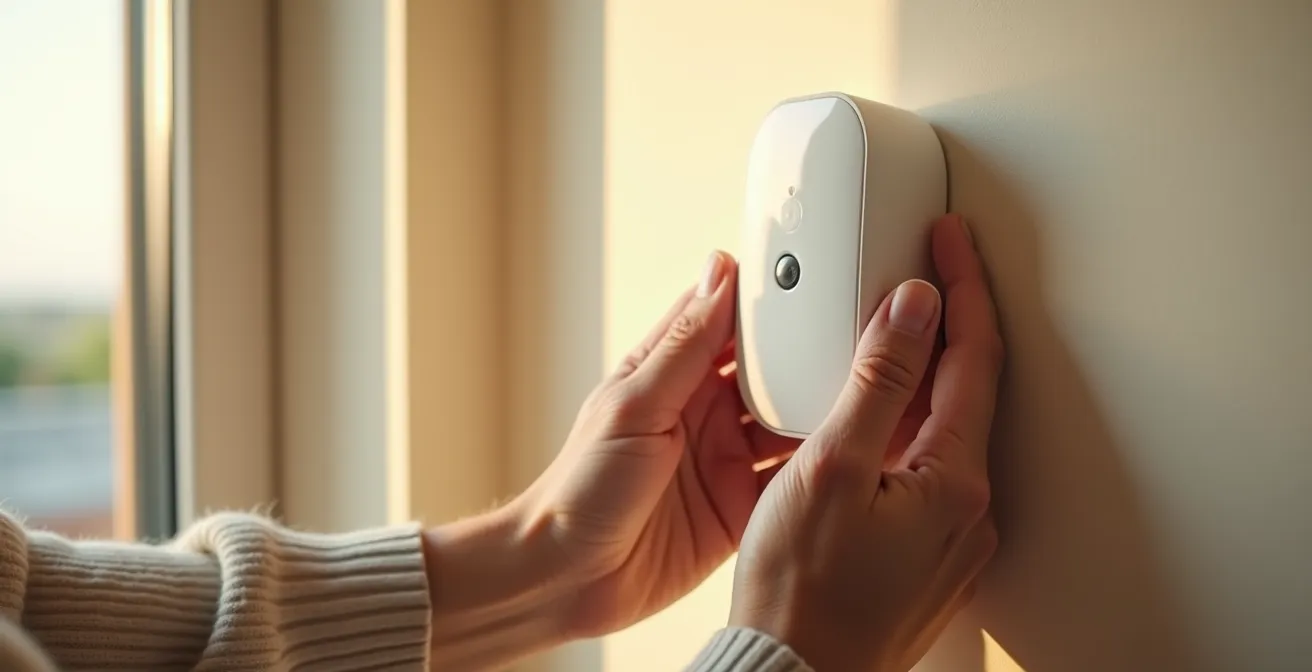
As shown, the physical installation should be simple and accessible. A system that is difficult to maintain will eventually be neglected, compromising its safety function. The following checklist provides a technical protocol for a tool-free, reliable installation.
Action Plan: Tool-Free Installation of a Safe Lighting Path
- Device Selection: Choose lights with magnetic mounts or stick-on adhesive strips rated to support at least 2 pounds.
- Placement Protocol: Install units at an accessible height (3-4 feet) to eliminate bending or climbing for battery replacement.
- Maintenance Minimization: Select models with a 6-month to 1-year battery life, preferably using common D-cell batteries for easy sourcing.
- Adaptive Mounting: Use 3M Command Strips instead of the included permanent adhesive for damage-free repositioning as mobility patterns change.
- System Calibration: Test light placement for a full 24-hour cycle before final installation to ensure optimal motion detection coverage and eliminate false trigger zones.
Hardwired vs. Battery-Powered Sensors: Which Is Reliable During Outages?
The debate between hardwired and battery-powered systems is often oversimplified. While hardwired lights are generally maintenance-free and brighter, their greatest weakness is a total dependence on grid power. During a power outage—often occurring during storms when emergency services are strained—a hardwired system fails completely, plunging a home into darkness at the worst possible moment. This represents a single point of failure that is unacceptable in a safety-critical system.
Battery-powered systems, conversely, are completely immune to power outages. Their reliability is instead tied to battery life and quality. Modern LED motion lights can achieve up to 1 year of regular use with quality D-cell batteries, and many include low-battery indicators that provide ample warning for replacement. While their brightness is typically lower (80-500 lumens vs. 500-2000 for hardwired), this is often an advantage for nighttime navigation, as excessive brightness can cause temporary flash blindness and disrupt circadian rhythms.
From an engineering perspective, the optimal solution is not a choice between one or the other, but a redundancy protocol. The primary pathway should ideally use hardwired lighting for daily, maintenance-free operation. However, this must be supplemented with a secondary, battery-powered system along the same path. This hybrid approach provides the best of both worlds: high-performance daily use and a fail-safe backup that guarantees illumination and safety during a power failure.
The following table, based on extensive product analysis, breaks down the critical differences. Note the “Power Outage Performance” row, which is the single most important factor for a true safety system.
| Feature | Hardwired Systems | Battery-Powered Systems |
|---|---|---|
| Power Outage Performance | Fails immediately unless connected to UPS backup | Continues working with quality batteries |
| Installation Cost | $150-300 with electrician | $0 – DIY in minutes |
| Brightness Output | 500-2000 lumens typical | 80-500 lumens typical |
| Maintenance | Minimal – annual bulb replacement | Battery replacement every 6-12 months |
| Long-term Reliability | Excellent with power available | Good with quality batteries and low-battery indicators |
A system is only as reliable as its weakest link. For hardwired systems, that link is the power grid. A battery backup is not a luxury; it is a mandatory component of a fail-safe design.
The Sensitivity Error That Wakes You Up Every Time a Pet Passes
A common and highly disruptive failure mode of motion sensors is over-sensitivity, leading to false triggers. This is frequently caused by household pets. A light that activates every time a cat or small dog walks by is not just an annoyance; it becomes a source of sleep disruption for the entire household. Frustrated users often end up disabling the system entirely, negating its safety benefits. Therefore, achieving pet immunity is not a convenience feature—it is critical for system adoption and long-term use.
There are two primary methods for engineering pet immunity: technological and physical. The technological solution involves using advanced PIR sensors with built-in intelligence. These sensors can be programmed to ignore movement from smaller heat signatures or to require multiple detection pulses before triggering, a feature that small, fast-moving animals are less likely to activate.
Case Study: Pet-Immune PIR Technology
Specialized sensors like the Honeywell 5800PIR offer a technical solution. This device features two sensitivity settings controlled by its programming. The first mode provides high pulse count with low sensitivity, which maintains pet immunity for animals under 40 lbs. A second, more sensitive mode can be activated if no pets are present. This dual-mode approach allows the system to be precisely calibrated to the home’s environment, balancing reliable human detection with the avoidance of false pet-related triggers.
The second method, immunity zoning, is a physical, low-tech but highly effective technique. It involves strategically masking a portion of the sensor’s Fresnel lens. Since pets are low to the ground, applying a small piece of opaque tape to the bottom third of the sensor’s lens effectively creates a “blind spot” in the detection zone at floor level. The sensor will no longer “see” movement below a certain height, rendering pets invisible to it while still detecting an upright human walking past. This simple modification can solve the vast majority of pet-related false alarms.
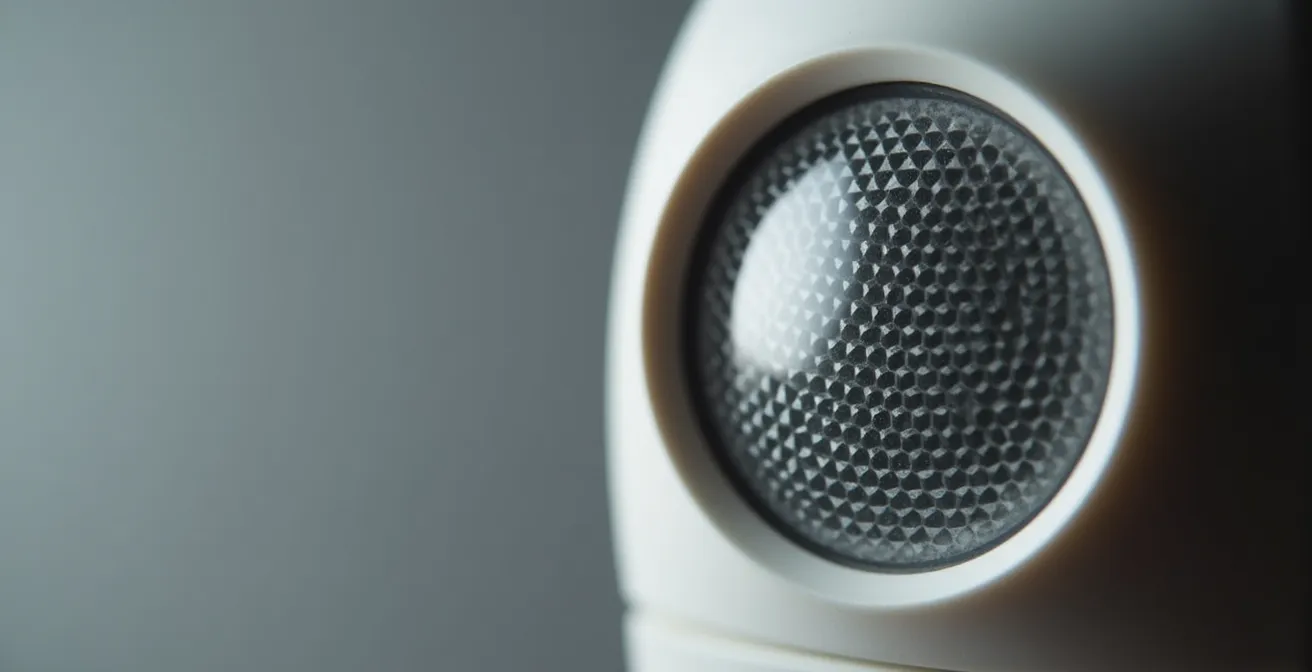
This macro view shows the precise application of tape on a PIR lens. This “immunity zoning” is a powerful design tool for calibrating a sensor to its specific environment, ensuring the system serves its primary purpose without causing unnecessary disruption.
When to Use Warm vs. Cool Light to Preserve Sleep Cycles for Seniors?
The quality of light is as important as its presence. The color temperature of a light source, measured in Kelvin (K), has a profound biological effect. Cool, blue-toned light (above 3000K) is a powerful stimulant that mimics daylight. It signals the brain to suppress the production of melatonin, the hormone that regulates sleep. Exposing a senior to cool, bright light during a nighttime trip to the bathroom can effectively reset their internal clock, making it incredibly difficult to fall back asleep. This leads to sleep deprivation, which increases disorientation and the risk of a fall the next day.
For any nighttime application, the lighting protocol must be strict: use only warm-toned light sources under 2700K. This type of light, often described as amber or soft white, has very little blue light in its spectrum. It provides sufficient illumination for safe navigation without disrupting the body’s natural circadian rhythm. The goal is to illuminate the path, not to wake the person up. This is a non-negotiable principle of safe nighttime lighting design.
Furthermore, the intensity, measured in lumens, should be low. A range of 80-150 lumens is typically sufficient for a hallway or staircase. This is bright enough to reveal obstacles but gentle enough to preserve night vision. When the eye adapts to darkness, a sudden blast of intense light can cause temporary “flash blindness,” a disorienting effect that is itself a fall hazard. The transition from darkness to light must be gentle. This means using multiple, low-intensity light sources to create an even “wash” of light rather than a single, high-intensity “spot” light.
Any light that bleeds into the bedroom from the hallway or bathroom constitutes light contamination and can fragment sleep, even if the person isn’t fully conscious of it. Therefore, the lighting system should only activate in the immediate vicinity of the person and extinguish quickly after they have passed. The system must light the way, then restore darkness to protect restorative sleep.
Why the Bathroom Is the Most Dangerous Room for Seniors Living Alone?
The bathroom combines multiple risk factors into a small, confined space: hard, unforgiving surfaces (tile, porcelain), wet and slippery floors, and the need to navigate complex movements like sitting, standing, and stepping over a tub edge. For a senior who may be groggy or disoriented at night, this room represents the most hazardous point in the home. Data from the Centers for Disease Control and Prevention shows approximately 235,000 Americans are injured in bathroom falls each year, a disproportionate number of whom are older adults.
Effective lighting design for this area must go beyond a single overhead fixture. The goal is to create layers of automatic, task-specific light. The pathway from the bedroom must lead to a clearly illuminated “destination cue”—the bathroom doorway. This can be achieved with low-profile LED strips framing the door, providing a clear visual target from down the hall. This simple cue reduces navigational uncertainty, a key contributor to hesitation and falls.
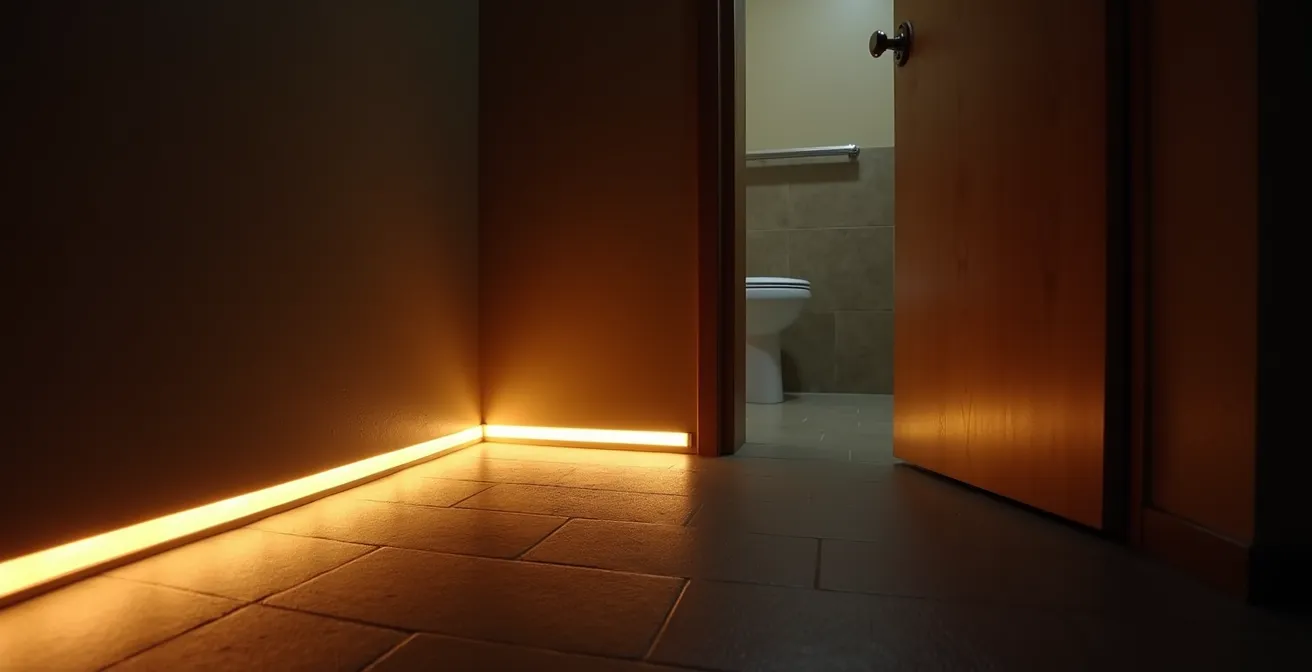
Inside the bathroom, the lighting should be multi-zoned. A low-lumen, motion-activated nightlight should provide immediate ambient illumination upon entry. This should be followed by automatic, task-oriented lighting, such as under-cabinet LEDs or a soft light around the vanity mirror, that activates when a person approaches the toilet or sink. This layered approach ensures that the right amount of light is delivered precisely where and when it is needed, without causing glare or requiring the user to fumble for a switch in the dark.
Case Study: Integrated Bathroom Lighting System
In a documented case, a senior who had fallen trying to use the bathroom at night was equipped with an integrated lighting solution. This included motion-activated pathway lights from his bedroom, an amber nightlight in the bathroom to preserve his sleep cycle, and automatic under-cabinet lighting. The results were immediate and profound. His family reported he felt safer and hadn’t fallen since the installation. This destination visual-cue lighting strategy was credited with a more than 30% reduction in nighttime falls in a patient group, proving the efficacy of a systemic, layered approach.
How to Blackout a Senior Bedroom for Deeper Restorative Sleep?
Fall prevention begins before a senior even gets out of bed. The quality of their sleep has a direct impact on their cognitive function, balance, and reaction time. Deep, restorative sleep is a powerful defense against falls, yet it is often compromised by light contamination within the bedroom itself. Even minute sources of light—from streetlights, digital clocks, or charging electronics—can disrupt the production of melatonin and prevent the brain from reaching the deepest stages of sleep.
Achieving a near-total blackout is a critical, yet often overlooked, aspect of home safety. According to 2024 data from the National Council on Aging, 1 in 4 Americans age 65+ falls each year, making any measure that improves physiological stability, like sleep, a primary line of defense. The engineering goal for the bedroom is to eliminate every photon of unwanted light.
The primary source of light contamination is typically windows. Standard curtains or blinds are insufficient. The solution is to install 100% blackout curtains that are wider and taller than the window frame itself. Mounting the curtain rod several inches above and to the sides of the frame allows the fabric to wrap around the edges, creating a seal that prevents light from leaking in. For best results, use curtains with a magnetic or Velcro closure in the center to seal the gap between the two panels.
The second step is an audit of all in-room electronics. Every device with a standby light—televisions, cable boxes, smoke detectors, phone chargers—is a source of sleep-disrupting blue light. The protocol is simple: cover every single LED with a small piece of black electrical tape. This is a zero-cost, 100% effective solution. For digital clocks, choose models with a red LED display, as red light has the least impact on melatonin, or turn the clock to face the wall. Creating a true “sleep sanctuary” is a foundational element of a holistic fall prevention strategy.
Key Takeaways
- System Redundancy is Key: A hybrid system of hardwired and battery-powered lights is the only way to guarantee illumination during a power outage.
- Sensor Technology Matters: Prioritize PIR sensors with digital temperature compensation to ensure detection of slow movement in cold conditions.
- Light Quality is Non-Negotiable: Always use warm light (under 2700K) at low intensity (80-150 lumens) for nighttime paths to protect sleep cycles and prevent disorientation.
How to Improve Indoor Mobility in a Small Apartment Without Major Works?
Implementing a comprehensive safety lighting system is not limited to large homes. The principles of path lighting, sensor reliability, and light quality can be effectively applied in smaller spaces like apartments, often with greater ease and lower cost. In a small apartment, the travel distance between bedroom and bathroom is shorter, but the path may be more cluttered or complex. The design goal is to use light to create clear, uncluttered “islands of safety” and navigational cues without requiring any structural changes.
In a constrained space, the placement of lights is even more critical. Vertical LED strips can be used to frame doorways, providing powerful visual cues without taking up floor or wall space. Small, battery-operated “puck” lights can be placed on bookshelves or the undersides of tables at knee-height to illuminate potential trip hazards like furniture legs or rugs. The key is to think in three dimensions and use existing surfaces to mount lights discreetly.
Case Study: Small Apartment Lighting Transformation
A senior living in a 600-square-foot apartment successfully transformed her nighttime safety using only battery-powered motion sensors. Wireless lights were placed on bookshelves at a 3-foot height to avoid bending, stick-on LED strips lined doorframes vertically to act as visual guides, and motion-sensing nightlights created a clear path to the bathroom. The entire installation, as detailed in a report by a home modification service, took under two hours and required no tools beyond the included adhesive strips, dramatically improving navigational safety.
A professional assessment can further optimize safety in any living space. As experts from the American Public Health Association point out, a formal review by a trained professional yields significant results. Their research highlights that these interventions are highly effective:
Home safety assessments performed by occupational therapists reduce fall rates by 21% to 31%.
– American Public Health Association, APHA Policy on Falls Prevention
This reinforces the idea that a lighting system, while crucial, is one component of a larger safety strategy that should also include decluttering, securing rugs, and installing grab bars. A well-designed lighting system in a small apartment doesn’t just illuminate the path; it makes the existing space fundamentally safer and easier to navigate.
By shifting the focus from individual products to an integrated, redundant, and intelligent system, it is possible to create a home environment that offers true, 24/7 protection. The next logical step is to conduct a detailed audit of your own home to identify these potential failure points and engineer the appropriate solutions.