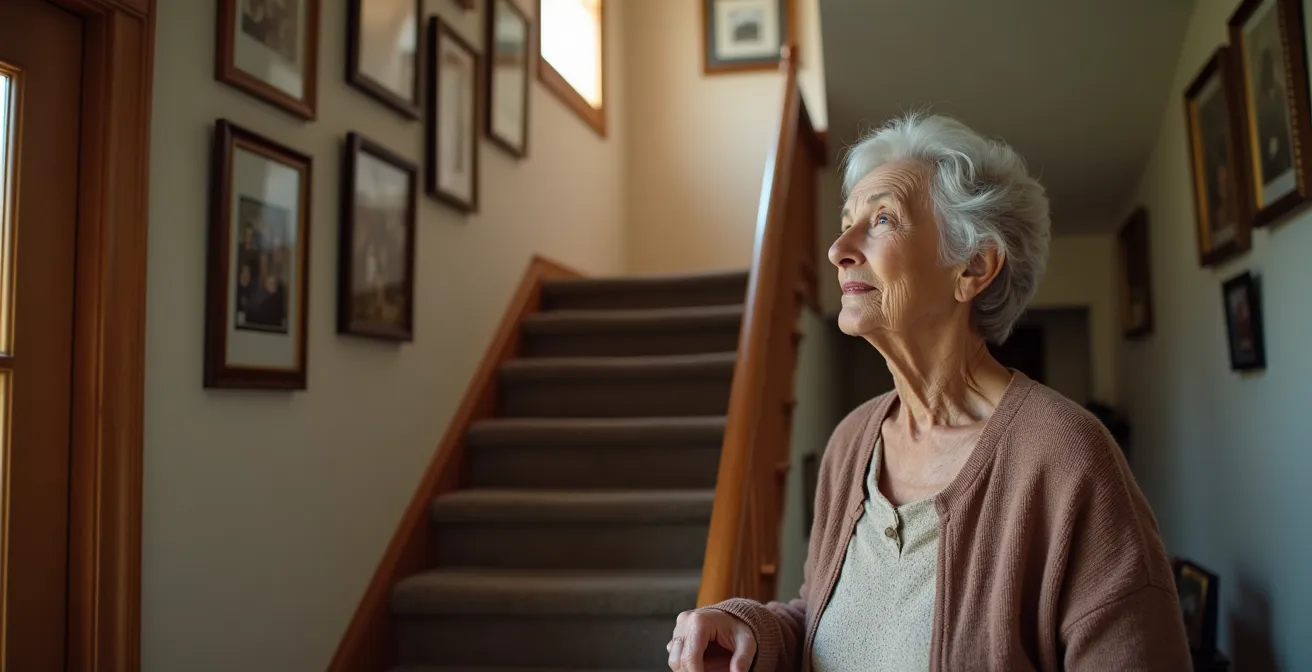
The viability of aging in place after 85 depends less on home modifications and more on creating a dynamic ‘safety ecosystem’ that proactively monitors for pattern disruptions, not just reacts to falls.
- Cognitive unawareness, not stubbornness, is often the biggest unseen risk, making self-reporting unreliable.
- Passive, dignity-preserving technology provides a more sustainable and less intrusive monitoring solution than cameras or constant calls.
- Strategically outsourcing chores conserves a senior’s finite energy for activities that boost mental and social health.
Recommendation: Shift your focus from a static safety checklist to building an adaptive support system that evolves with your parent’s changing needs.
As an adult child, you’ve likely asked the question that keeps you up at night: can my parent truly and safely continue to live alone as they move past 85? The desire for independence is a powerful, deeply human need, and your parent’s wish to remain in their own home is something to be honored. The conventional advice is familiar: install grab bars, get a medical alert pendant, and arrange for neighbors to check in. We are told to create a safety plan, and we diligently follow the checklists.
But these measures, while important, often address the most obvious risks while ignoring the subtle, creeping challenges that define advanced age. What happens when the issue isn’t a slippery floor but a slow, unnoticed cognitive decline? What if the real danger isn’t a fall, but the quiet despair of social isolation or the exhaustion from trying to maintain a household? The conventional approach is reactive, designed to respond to a crisis after it has already happened. It’s a safety net with holes.
This article challenges that paradigm. We propose that ensuring a parent’s well-being is not about creating a fortress of safety gadgets, but about building a dynamic, data-driven ‘safety ecosystem’. This system is designed to anticipate needs by monitoring for subtle disruptions in daily patterns, preserving dignity while providing you with true peace of mind. It’s about shifting from crisis response to proactive, intelligent support.
Throughout this guide, we will deconstruct the core challenges of solitary aging and provide strategic frameworks to build this resilient ecosystem. We will explore how to identify risks your parent may not even be aware of, structure support that respects their privacy, and make the tough decisions about when the home environment itself becomes untenable.
Summary: A Strategic Guide to Viable Aging in Place After 85
- Why Cognitive Decline Often Goes Unnoticed Until a Crisis Occurs?
- How to Structure a Daily Check-In Routine for Remote Caregivers?
- Single-Story vs. Multi-Level: When Is Moving Inevitable for Safety?
- The Emergency Response Gap That Endangers Seniors Without Medical Alerts
- How to Bring Community Activities to the Home for Less Mobile Seniors?
- Why Passive Activity Monitoring Is Less Intrusive Than Video Feeds?
- Why Outsourcing Chores Improves Mental Health for Solitary Seniors?
- Telecare Systems for Dementia: Which Features Respect Privacy While Ensuring Safety?
Why Cognitive Decline Often Goes Unnoticed Until a Crisis Occurs?
One of the most frustrating and frightening challenges for an adult child is the gap between the reality you observe and the reality your parent describes. You notice missed appointments, repetitive stories, and a decline in household upkeep, yet when you gently inquire, your parent insists everything is fine. This isn’t necessarily denial or stubbornness; it’s often a neurological symptom called anosognosia, or a “cognitive blindspot.” It is the brain’s inability to recognize its own deficits, a condition that is terrifyingly common. In fact, compelling research published in Scientific Reports reveals that up to 80% of patients diagnosed with AD dementia experience this profound lack of awareness.
This means you cannot rely on your parent to be a reliable reporter of their own struggles. Their assurance that they are “doing just fine” may be completely genuine to them, even as the risks around them mount. The crisis—a fall, a medication error, a kitchen fire—often becomes the first undeniable signal that the support system has failed. Understanding the difference between this neurological condition and psychological denial is critical for caregivers.
Case Study: Anosognosia vs. Psychological Denial
A 2024 study from Barrow Neurological Institute documented the crucial distinction. One patient with genuine anosognosia was truly unaware of his memory problems, a direct result of his brain pathology. Another patient initially denied her difficulties due to anxiety and fear of losing independence but was later able to acknowledge them when approached with empathy and support. This highlights that while one is a fixed neurological issue, the other can be addressed with careful communication. For a caregiver, determining which is at play is the first step in structuring effective support.
Because of this cognitive blindspot, objective, external monitoring of daily patterns becomes not just helpful, but essential. It is the only way to get a true baseline of well-being and be alerted to the subtle changes that precede a full-blown crisis. Waiting for your parent to ask for help may mean you are waiting too long.
How to Structure a Daily Check-In Routine for Remote Caregivers?
Once you accept that you need an external view of your parent’s well-being, the question becomes how to get it without being intrusive. A daily check-in is fundamental, but its structure determines whether it’s a source of connection or a daily chore that breeds resentment. The goal is to gather meaningful data efficiently while reinforcing your relationship. A “How are you?” call often yields a reflexive “I’m fine.” A more structured approach is needed.
A “triage call” can be highly effective. This is a brief, purposeful 5-minute call with a consistent set of questions: “Did you take your morning medication?”, “What are you planning for lunch?”, “What’s one thing you’re looking forward to today?”. This provides concrete information while also opening the door for more natural conversation. However, this active method must be balanced with passive data streams that paint a picture of daily life without requiring direct interaction. This is the foundation of the ‘safety ecosystem’.
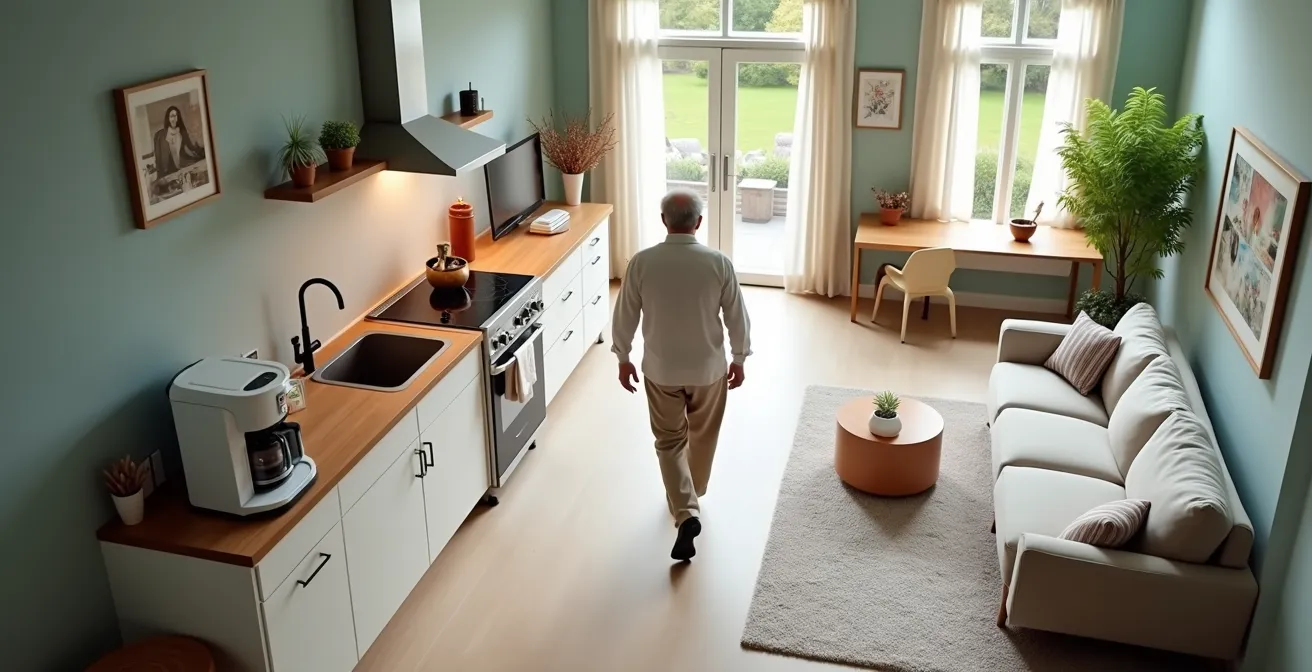
As the illustration shows, modern smart home devices can create a ‘digital breadcrumb trail’ of activity. A sensor on the fridge door confirms they’re accessing food, a motion sensor in the hallway tracks mobility patterns, and a smart pill dispenser logs medication adherence. This isn’t surveillance; it’s the collection of anonymous data points that together confirm a normal pattern of daily living. An alert is only triggered when a pattern is disrupted—the fridge hasn’t been opened by 10 AM, or there’s been no movement out of the bedroom.
Choosing the right method, or combination of methods, involves a trade-off between the quality of information gathered and the perceived intrusiveness. The following table breaks down the most common approaches.
| Check-In Method | Time Required | Data Quality | Senior Acceptance | Technology Needed |
|---|---|---|---|---|
| 5-Minute Triage Call | 5 mins daily | High – structured questions | High – brief and purposeful | Phone only |
| Video Call Assessment | 15-20 mins | Very High – visual cues | Medium – feels intrusive | Smartphone/tablet |
| Text Check-In System | 2 mins | Low – limited detail | High – non-invasive | Basic cell phone |
| Smart Device Monitoring | Passive | Medium – activity patterns | High – no interaction needed | Smart home devices |
Single-Story vs. Multi-Level: When Is Moving Inevitable for Safety?
No amount of technology can compensate for a home that is fundamentally unsafe for a person with declining mobility. For a senior living in a multi-level house, stairs become the single greatest daily risk. The decision to move to a single-story home or an assisted living facility is emotionally fraught, but it must be driven by a realistic safety assessment, not just sentiment. The key question is: can all essential daily activities be safely performed on a single floor?
Financially, the choice is often framed as a trade-off between modifying the current home and the high cost of residential care. While retrofitting a home with features like a stairlift or a downstairs bathroom can be expensive, it is often far more cost-effective in the long run. Data shows that the one-time investment in modifications pales in comparison to the recurring, and often escalating, costs of assisted living. For instance, according to Consumer Affairs and NAHB data, average aging-in-place remodeling costs can be around $10,000, whereas a single year in an assisted living facility can exceed $50,000.
However, the decision isn’t purely financial. Before investing in major modifications like a stairlift, you must conduct a frank “Main Floor Viability Test.” If the ground floor cannot be adapted to contain a full bedroom, a full bathroom, and a functional kitchen, then navigating stairs will remain a daily, non-negotiable requirement. At that point, the risk of a fall becomes a matter of “when,” not “if,” and moving becomes an unavoidable safety imperative. This objective checklist can help you make that difficult assessment.
Your Main Floor Viability Checklist
- Bathroom Access: Verify the presence of a full bathroom on the ground floor or confirm there is space to install one with a walk-in shower.
- Bedroom Feasibility: Confirm an existing room can be converted into a bedroom, ensuring it has a proper emergency egress window.
- Kitchen Accessibility: Assess if the kitchen and pantry can be fully accessed and used without navigating any steps or stairs.
- Mobility Pathways: Calculate the maneuverability space, ensuring all doorways are at least 36 inches wide to accommodate walkers or wheelchairs.
- Emergency Egress: Time a 2-minute emergency evacuation route from the proposed main floor bedroom to a safe exterior location.
The Emergency Response Gap That Endangers Seniors Without Medical Alerts
The classic image of senior safety is the medical alert pendant. While these devices are a critical layer of any safety ecosystem, relying on them alone creates a dangerous illusion of security. The problem lies in what experts call the “emergency response gap”: the period between when an incident occurs and when help is actually requested. This gap exists for two primary reasons: the senior is unable to activate the device (due to being unconscious or disoriented), or they are unwilling to (due to not wanting to be a “bother”).
The statistics on falls are staggering and underscore the severity of this risk. Falls are the leading cause of fatal and non-fatal injuries among older adults. Indeed, CDC data cited by The Senior Source shows that over 14 million falls are reported yearly among adults 65 and older. When a senior falls and is unable to press their button, they can lie on the floor for hours, leading to complications like dehydration, pressure sores, and hypothermia, which are often more damaging than the fall itself. This is where the limitations of traditional, user-activated systems become a life-threatening liability.
Modern technology is closing this gap with automatic fall detection. These systems, often built into smartwatches or discreet wearables, use accelerometers and gyroscopes to detect the specific signature of a hard fall. If a fall is detected and the wearer doesn’t get up or respond to a prompt within a minute, the system automatically alerts family members and emergency services. This removes the burden of activation from the senior, turning a reactive tool into a proactive one.
Case Study: How Automatic Detection Closes the Response Gap
A Florida senior living technology report documented how automatic fall detection systems with built-in GPS drastically improved outcomes. In documented cases, emergency response times were reduced from an average of 4-6 hours (for falls where the person could not call for help) to under 30 minutes. One powerful example involved a senior who fell and lost consciousness in his bathroom. His smartwatch detected the impact, simultaneously alerted his daughter and 911, and provided his exact location within the home, allowing paramedics to find him quickly. This shift from manual to automatic alerting is arguably the single most important evolution in senior safety technology.
How to Bring Community Activities to the Home for Less Mobile Seniors?
A robust safety ecosystem addresses physical risks, but a truly viable plan for aging in place must also combat the silent epidemic of social isolation. As mobility decreases, a senior’s world can shrink to the four walls of their home. The community center trips, card games with friends, and volunteer activities that once provided purpose and connection fall away, often leading to depression and accelerated cognitive decline. The challenge is to reverse this trend and bring the community back into the home.
Technology is the most powerful tool for this. While video calls with family are a start, they are not a substitute for peer-to-peer interaction and engagement in meaningful activities. The goal is to facilitate purposeful connection, not just passive communication. Universities and community organizations are increasingly offering virtual classes specifically for seniors, covering everything from art history to gentle yoga. These create a structured social environment and a sense of shared learning.

Furthermore, virtual volunteering and mentoring platforms offer a profound sense of purpose. As the image suggests, a senior can use their lifetime of experience to mentor a student or young professional from the comfort of their home office. Programs that connect seniors with children for virtual story time or homework help create powerful intergenerational bonds that benefit both parties. These are not just ways to pass the time; they are vital roles that restore a sense of identity and self-worth.
Finally, don’t underestimate the power of shared interests. Online book clubs, virtual gardening groups, and even multiplayer digital board games allow seniors to connect with others who share their passions, transcending physical limitations. Setting up these systems may require initial help from family, but the long-term payoff in mental and emotional well-being is immeasurable. It’s about curating a digital life that is as rich and engaging as their former physical one.
Why Passive Activity Monitoring Is Less Intrusive Than Video Feeds?
The idea of monitoring a parent’s home can feel like a profound invasion of privacy, for both you and them. The thought of installing video cameras, while seemingly offering the most information, often crosses a line that damages trust and dignity. The key to a successful ‘safety ecosystem’ is to gather the necessary data with the least intrusive method possible. This is the fundamental difference between active surveillance and passive activity monitoring.
Video cameras answer the question, “What is Dad doing right now?” This level of detail is rarely necessary and creates a stressful dynamic for everyone. It can make a parent feel constantly watched and judged, while burdening the caregiver with the need to perpetually “check the feed.” Passive monitoring, on the other hand, answers a much more important question: “Is Dad’s day normal?” It achieves this by using simple, non-visual sensors to track routines and patterns.
Jodi Waterhouse, a specialist at the UCHealth’s Multidisciplinary Center on Aging, frames this distinction perfectly:
Passive monitoring tracks patterns and routines, answering ‘Is Dad’s day normal?’ while video surveillance tracks specific actions, answering ‘What is Dad doing right now?’, which erodes privacy
– Jodi Waterhouse, UCHealth – Multidisciplinary Center on Aging
This approach preserves senior dignity because the monitoring is invisible and the data collected is anonymous. A sensor on the front door logs that it was opened at 9 AM for the newspaper, a motion sensor registers activity in the kitchen during lunchtime, and a pressure sensor on a favorite armchair shows they are resting in the afternoon. You don’t see what your parent is doing; you simply see a daily report confirming that the expected rhythm of their day is intact. An alert is only generated if a key part of that rhythm is broken, allowing you to intervene when patterns are disrupted, not just when a crisis occurs.
This table clearly illustrates the trade-offs between these two philosophies of monitoring, highlighting the superior privacy and reduced stress offered by passive systems.
| Monitoring Aspect | Passive Sensors | Video Cameras |
|---|---|---|
| Data Collected | Movement patterns, room presence | Visual footage, facial expressions |
| Privacy Level | High – no visual recording | Low – constant visual surveillance |
| Caregiver Stress | Reduced – summary reports only | Increased – constant watching possible |
| Senior Dignity | Preserved – invisible monitoring | Compromised – aware of being watched |
| Alert Type | Anomaly-based only | Continuous or motion-triggered |
Why Outsourcing Chores Improves Mental Health for Solitary Seniors?
Maintaining a home is physically and cognitively demanding. For a senior living alone, the daily and weekly chores—laundry, cooking, cleaning, yard work—can become a source of immense stress and a constant reminder of declining abilities. When an aging parent starts struggling with these tasks, it’s often misinterpreted as laziness or apathy. In reality, it can be a direct symptom of cognitive overload and diminishing physical energy. Indeed, National Institute on Aging research indicates that 22% of Americans aged 71 and older experience cognitive decline that directly impacts their ability to manage daily tasks.
The solution is not to nag or criticize, but to reframe the problem strategically. This is where the “Energy Conservation Model” comes in. This model treats a senior’s daily energy—both physical and mental—as a finite resource. Every ounce of energy spent on a physically demanding or cognitively complex chore is energy that cannot be spent on something more fulfilling, like a social call, a hobby, or light exercise. Outsourcing tasks like deep cleaning, grocery shopping, or lawn maintenance isn’t “giving up”; it is a strategic reallocation of that precious energy toward activities that promote mental health and social connection.
This shift in mindset can have a profound impact on a senior’s sense of self-worth and control. Instead of feeling like they are failing to keep up, they can adopt the role of a household manager, directing resources intelligently. This preserves their autonomy while freeing them from the tasks that cause the most frustration and risk of injury.
Case Study: The “CEO of the Home” Mindset
The Senior Friendship Centers in Sarasota documented the success of this ‘energy conservation’ approach. In their program, seniors who strategically outsourced demanding physical chores maintained their social activities and hobbies 40% longer than a control group who attempted to manage everything independently. One 87-year-old participant powerfully summarized the psychological benefit, reporting that the shift made her feel “like a CEO rather than a failing housekeeper.” This restored sense of control is a critical component of positive mental health in later life.
Key Takeaways
- Aging in place successfully after 85 requires a proactive ‘safety ecosystem’, not just a reactive safety net.
- Cognitive blindspots (anosognosia) are a common neurological symptom, making a senior’s self-assessment of their abilities unreliable.
- Dignity-preserving passive monitoring, which tracks patterns rather than specific actions, is superior to intrusive video surveillance.
Telecare Systems for Dementia: Which Features Respect Privacy While Ensuring Safety?
As cognitive decline progresses, especially with a dementia diagnosis, the ‘safety ecosystem’ must evolve. The technology required for someone in the late stages of dementia is very different from what’s needed for an independent senior with mild memory issues. Implementing technology in a staged, progressive manner is the key to maintaining the delicate balance between safety and autonomy for as long as possible. Flooding a home with advanced monitoring tools too early can feel overwhelming and insulting, while waiting too long can be catastrophic.
A staged technology framework allows you to introduce new layers of support as specific needs arise. In the early stages, the focus is on user-controlled aids that assist with memory and organization. As the disease progresses to the mid-stage, the focus shifts to preventing specific, high-risk events like wandering or leaving a stove on. It’s only in the late stages that more continuous, lower-privacy monitoring becomes a necessary safety measure.
Even within a specific technology, features can be chosen to maximize dignity. For instance, a geo-fencing system is far more respectful of privacy than constant geo-tracking. As experts from Florida Senior Consulting note, ” Geo-fencing creates a ‘safe zone’ and only alerts if the boundary is crossed, allowing freedom and dignity within that zone, while constant geo-tracking provides real-time location at all times, which can feel like surveillance.” This principle of “alerting on anomaly” rather than “constant tracking” should guide all technology choices.
The following table provides a clear model for how technology can be staged to align with the progression of dementia, ensuring that each intervention is appropriate, timely, and as respectful of privacy as possible.
| Dementia Stage | Recommended Technology | Privacy Level | Safety Features |
|---|---|---|---|
| Early Stage | Smart calendars, medication reminders | High – user controlled | Prevents missed medications/appointments |
| Mid Stage | Geo-fencing, stove sensors | Medium – boundary alerts only | Prevents wandering, fire hazards |
| Late Stage | Bed-exit alarms, fall detection | Lower – continuous monitoring | Immediate emergency response |
Building this adaptive, multi-layered safety ecosystem is the most meaningful way to honor your parent’s desire for independence while fulfilling your responsibility to ensure their safety. The next step is to begin assessing which layers of this ecosystem are most needed today.