Mobility and rehabilitation
Movement is more than just getting from one room to another—it’s the foundation of independence, dignity, and quality of life. Whether you’re recovering from surgery, managing a chronic condition, or experiencing age-related changes in strength and balance, mobility and rehabilitation strategies can dramatically transform your daily experience. The right combination of equipment, home modifications, and adaptive techniques doesn’t just prevent falls; it opens doors to confidence and autonomy.
This comprehensive resource explores the essential components of mobility and rehabilitation, from selecting the appropriate walking aid to optimizing your home environment. You’ll discover practical guidance on stability devices, vertical mobility solutions like stairlifts, and adaptive equipment that restores function in everyday tasks. Our goal is to equip you with the knowledge to make informed decisions that match your unique needs and lifestyle.
Why Mobility Matters: Independence, Safety, and Quality of Life
Maintaining functional mobility extends far beyond physical health—it directly impacts mental wellbeing, social engagement, and self-determination. Studies consistently show that individuals who maintain safe movement patterns experience lower rates of depression, better cognitive function, and stronger social connections. When movement becomes challenging or painful, many people unconsciously begin limiting their activities, creating a gradual spiral of decreased strength, confidence, and independence.
The rehabilitation process addresses this cycle by focusing on three interconnected goals. First, it preserves your existing capabilities through proper technique and supportive equipment. Second, it systematically builds strength and endurance where possible. Third, it compensates for permanent limitations through smart environmental modifications and assistive devices. This holistic approach recognizes that mobility isn’t just about walking—it encompasses transfers, reaching, bending, and navigating your entire living space safely.
Understanding your specific mobility challenges is the crucial first step. Some individuals face balance issues requiring stability support, while others manage fatigue that demands energy-conserving strategies. Joint pain might necessitate friction-reducing modifications, and cognitive changes may require simplified pathways. Identifying your primary limitation allows you to prioritize solutions that deliver the greatest impact on your daily life.
Making Your Home Safe for Movement
Your home environment plays an equally important role as equipment in supporting safe mobility. Small, often invisible obstacles create significant fall risks, yet most can be addressed through thoughtful arrangement and simple modifications. The goal is to create clear pathways that allow fluid movement without constant vigilance or navigation challenges.
Identifying and Removing Obstacles
Walk through your home with fresh eyes, looking specifically for hazards that interrupt smooth movement. Common culprits include electrical cords crossing pathways, area rugs with curled edges, low furniture like ottomans, and pet bowls placed in traffic zones. Even seemingly minor items—magazines stacked on the floor, shoes left near doorways, or decorative plants in hallways—can become trip hazards when you’re fatigued or distracted.
Consider the turning radius required for your mobility aid. Walkers and wheelchairs need substantially more maneuvering space than most homes naturally provide. Rearranging furniture to create wider corridors, even if it means sacrificing a decorative table or chair, dramatically reduces the physical effort and concentration required for daily navigation.
Lighting and Flooring Considerations
Inadequate lighting creates depth perception problems and shadows that disguise hazards. Install lighting that eliminates dark corners, particularly in transitional spaces like hallways and staircases. Motion-activated night lights prevent the dangerous combination of darkness and half-asleep navigation during nighttime bathroom trips.
Flooring transitions deserve special attention. The shift from carpet to tile, or the slight lip at doorway thresholds, can catch walker wheels or shuffle-walking feet. Beveled threshold ramps (typically ¼ to ½ inch high) smooth these transitions. For slippery surfaces, consider textured, non-slip coatings rather than throw rugs, which introduce their own tripping hazard.
Choosing Mobility Aids that Match Your Needs
Mobility aids exist on a spectrum, from minimal support devices to comprehensive transportation systems. Selecting the appropriate level requires honest assessment of your current capabilities, understanding of progressive conditions, and consideration of where you need to move. The right device should feel supportive without being cumbersome, and should match both your indoor and outdoor environments.
Canes and Walkers for Stability
Standard canes provide light balance support and are ideal when you need occasional steadying rather than significant weight-bearing assistance. They work well for mild balance issues or unilateral weakness. Quad canes, with their four-point base, offer greater stability and can stand independently, making them useful for individuals who need to free both hands momentarily.
Standard walkers (without wheels) provide maximum stability through their wide base and require you to lift the frame with each step. This lifting action, while stable, demands upper body strength and can be exhausting over distance. They excel in tight indoor spaces where precise control matters more than speed. Key considerations include:
- Proper height adjustment: your elbows should bend at approximately 15-20 degrees when gripping handles
- Hand grip comfort: foam, contoured, or ergonomic grips reduce hand fatigue and joint stress
- Base width: must fit through your narrowest doorway while providing adequate stability
Rollators for Active Lifestyles
Wheeled walkers, or rollators, transform mobility for individuals who tire easily but maintain reasonable balance. The wheels eliminate the need to lift, dramatically reducing energy expenditure and enabling longer distances. Most include a seat, allowing you to rest whenever fatigue strikes—a game-changing feature for outdoor activities like grocery shopping or park visits.
The brake system deserves careful evaluation. Loop brakes (similar to bicycle brakes) offer intuitive control and can be locked when sitting, while push-down brakes activate through downward pressure on handles. Wheel size significantly affects performance: larger wheels (8 inches) navigate outdoor terrain and thresholds more easily, while smaller wheels (6 inches) provide better maneuverability in confined indoor spaces.
Folding mechanisms vary in complexity. Some rollators collapse with a single pull strap, while others require multiple steps. Test the folding process before purchasing—you’ll need to manage it independently when loading into a vehicle or storing in tight spaces.
Power Wheelchairs and Scooters
Electric mobility devices suit individuals with severe mobility impairment, significant fatigue conditions, or limited walking endurance. Power wheelchairs offer precise indoor maneuverability and full-day sitting support with pressure-relieving cushions. Scooters provide outdoor range and speed but require better core stability and the ability to transfer on and off.
Drive wheel configuration affects performance dramatically. Front-wheel drive excels at obstacle climbing, mid-wheel drive provides the tightest turning radius for indoor use, and rear-wheel drive delivers the best outdoor stability at higher speeds. Your primary usage environment should guide this choice.
Battery range and charging cycles demand realistic planning. Most devices offer 10-20 miles per charge under ideal conditions, but hills, rider weight, and terrain reduce this significantly. Establishing a consistent charging routine—typically overnight, even after partial use—extends battery lifespan and prevents unexpected power loss.
Home Adaptations for Vertical Mobility
Stairs represent one of the most significant barriers to aging in place. When climbing becomes unsafe or impossible, two primary solutions maintain access to multi-level homes: stairlifts and motorized lift chairs. Each addresses different vertical navigation challenges.
Stairlifts: Engineering and Installation
Stairlifts mount to stair treads (or occasionally walls) and carry you seated up and down staircases. Modern systems accommodate straight runs, curves, landings, and even outdoor installations. The engineering involves precise rail measurement, motor sizing for your weight, and safety sensors that stop movement if obstacles are detected.
Installation typically requires professional assessment of your staircase structure, electrical supply, and clearance requirements. Rails must not obstruct other household members, and the seat must fold compactly when not in use. The process usually takes 4-8 hours for straight stairs, longer for curved configurations that require custom rail fabrication.
Purchase options range from new custom systems to refurbished units and rental arrangements. Straight stairlifts can sometimes be refitted between homes, while curved systems are property-specific. Maintenance contracts ensure regular safety inspections and battery checks, as most systems include backup power for electrical outages.
Lift Chairs: Motorized Seating Solutions
Lift chairs combine reclining comfort with motorized assistance for standing and sitting. The mechanism tilts the entire chair forward, raising you to a near-standing position that eliminates the difficult push-off motion. This proves invaluable for individuals with knee arthritis, hip weakness, or general deconditioning.
Measuring for proper fit is critical—your feet should rest flat on the floor when seated, with knees at approximately 90 degrees. The chair back must support your full spine height. Too large or too small, and the lift mechanism can’t position you correctly for safe standing.
Fabric choices affect both comfort and maintenance. Leather and vinyl wipe clean easily but can feel hot or sticky, while microfiber and velour provide breathability but absorb spills. Placement near electrical outlets is obvious but often overlooked—extension cords create trip hazards that undermine the safety these chairs provide.
Restoring Function Through Adaptive Tools
Mobility extends beyond walking to include the fine motor skills and manual dexterity required for daily tasks. Adaptive kitchen tools, bathroom equipment, and assistive technology compensate for reduced grip strength, limited reach, or joint pain that interferes with independence.
Kitchen adaptations demonstrate the principle of joint protection—using larger muscle groups and mechanical advantage instead of forcing painful joints. Examples include jar openers that leverage torque, built-up handle utensils that reduce grip force requirements, and reachers that eliminate dangerous overhead stretching. The key is identifying which specific tasks cause difficulty, then sourcing targeted solutions rather than accumulating gadgets that remain unused.
Timing matters when introducing adaptive equipment. Beginning too early can lead to unnecessary dependence, while waiting too long risks injury or the discouragement that comes from repeated failure. A useful guideline: adopt assistive tools when a task becomes consistently difficult or painful, but before it becomes impossible or dangerous.
Advanced assistive technology, including hearing enhancement devices and medication management systems, addresses cognitive and sensory aspects of independent living. These tools reduce the cognitive load of remembering complex schedules or struggling to hear important safety signals, allowing you to direct mental energy toward activities you value.
Keeping Your Independence Long-Term
Mobility and rehabilitation isn’t a one-time solution but an evolving process. Your needs will change, equipment requires maintenance, and new capabilities or limitations will emerge. Establishing regular review routines ensures your setup continues serving you effectively.
Equipment maintenance follows specific schedules. Walkers and rollators need periodic wheel replacement and brake adjustment. Power wheelchairs require battery testing, tire pressure checks, and electronic diagnostics. Stairlifts benefit from annual professional servicing. Neglecting these tasks leads to gradual performance degradation that you might not notice until a safety-critical failure occurs.
Equally important is monitoring your own progress and challenges. If you notice increasing difficulty with a previously manageable task, reassess whether different equipment or techniques might help. Rehabilitation isn’t about stubbornly maintaining the same approach—it’s about intelligently adapting to preserve maximum independence as circumstances evolve.
Remember that mobility aids and adaptations aren’t signs of giving up—they’re tools that enable you to continue living actively and safely. The goal isn’t to avoid assistance, but to strategically employ the right support that keeps you engaged with the people, places, and activities that make life meaningful.

Which Arthritis-Friendly Tools Actually Restore Independence in the Kitchen?
Giving up cooking due to arthritis pain is not inevitable; the solution isn’t a drawer full of gadgets, but a new way of thinking about kitchen tasks. True independence comes from prioritizing leverage over raw grip strength. The best tools…
Read more
Digital Hearing Aids: Why Do 40% of Seniors Buy Them but Never Wear Them?
The key to hearing aid adoption isn’t the device’s technology, but a strategic retraining of the user’s brain to handle a renewed world of sound. Initial rejection is often due to predictable cognitive overload as the brain struggles with sounds…
Read more
Beyond Amp-Hours: How to Choose a Power Wheelchair Battery for All-Day Outdoor Independence
Contrary to popular belief, the key to all-day power wheelchair independence isn’t just a bigger battery; it’s mastering your chair’s entire energy ecosystem. Hidden “energy taxes” like tight home layouts, improper joystick settings, and frequent power seating adjustments can drain…
Read more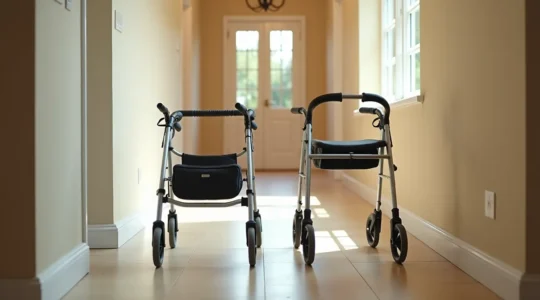
3-Wheel vs. 4-Wheel Rollators: Which Model Navigates Narrow Hallways Best?
Choosing a rollator for a small apartment goes far beyond a simple width measurement; it’s about mastering the spatial dynamics of your home. A 3-wheel rollator’s superior turning radius often makes it better for tight corners, even if a 4-wheel…
Read more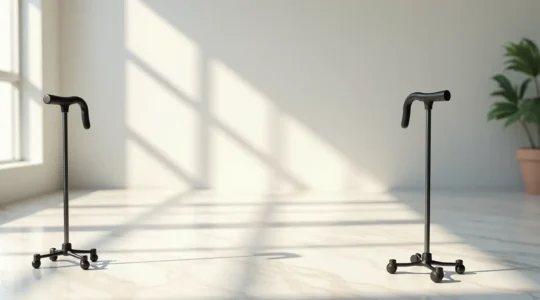
Quad Cane vs. Standard Cane: A Physiotherapist’s Guide to Stability and Recovery
The choice between a quad and standard cane is less about the number of legs and more about matching the device to your environment and using it with correct biomechanics. Incorrect height and using the cane on the wrong side…
Read more
1-Motor vs. 2-Motor Lift Chairs: Which Provides Better Back Support for Nap Taking?
Choosing between a 1-motor and a 2-motor (infinite position) lift chair is a crucial therapeutic decision that directly impacts orthopedic health and circulation, especially for napping. Dual-motor chairs offer independent backrest and footrest adjustments, which are vital for achieving specific…
Read more
Why Do Curved Stairlifts Cost So Much? A Transparent Look at Custom Rail Pricing
The steep price of a curved stairlift isn’t arbitrary; it directly reflects a complex process of precision engineering, custom manufacturing, and skilled installation required for safety on a non-standard staircase. The rail, which must perfectly match every curve and angle…
Read more
How to Improve Indoor Mobility in a Small Apartment Without Major Works?
In summary: Mobility isn’t about adding gadgets but removing environmental friction through strategic, reversible changes. Create dedicated “walking lanes” of at least 36 inches wide by repositioning furniture, not removing it. Prioritize uniform, diffuse lighting over single bright sources to…
Read more