
Undertaking structural modifications for accessibility is fundamentally a legal and engineering exercise, not merely a construction project.
- Removing any load-bearing wall is a material alteration that universally requires a building permit, architectural plans, and engineering oversight to maintain structural integrity.
- Hiring a Certified Aging-in-Place Specialist (CAPS) over a general contractor provides crucial expertise in safety compliance and future-proof design, mitigating long-term liability.
Recommendation: Before any demolition begins, your first step is to engage a structural engineer or architect to assess which walls are load-bearing, establishing the legal and procedural path forward for your project.
When planning to enhance home accessibility by removing walls, homeowners often focus on the physical transformation—the wider hallways, the open-plan living space. However, the most critical work begins long before the first swing of a sledgehammer. From a legal standpoint, these are not just renovations; they are “material alterations” to your property’s structural DNA. This distinction is paramount, shifting the conversation from interior design to legal compliance, structural engineering, and liability.
The common advice to simply “check with your local building department” is insufficient. It overlooks the underlying compliance framework that governs these projects. Failing to secure the correct permits isn’t just a bureaucratic misstep; it can void your homeowner’s insurance, create significant problems upon resale, and, most critically, compromise the physical safety of your home. The core issue is not whether you need a permit—for structural work, you do—but understanding the full scope of professional engagement and due diligence required.
This guide moves beyond the surface-level questions. It frames your renovation through the lens of a construction law specialist, focusing on the principles of structural integrity, chain of liability, and regulatory compliance. We will dissect the process, clarifying which walls can be moved, the professionals you are legally and practically required to hire, and the financial mechanisms to support these essential modifications. The objective is to empower you to navigate this complex process, ensuring your home is not only more accessible but also structurally sound and legally compliant.
Summary: A Legal and Structural Guide to Accessibility Renovations
- Why Widening Hallways Is the Only Solution for Power Wheelchair Access?
- How to Live in Your Home During a Major Bathroom Renovation?
- Load-Bearing vs. Partition Walls: Which Can Be Moved for Better Flow?
- The Demolition Mistake That Can Compromise Your Home’s Foundation
- How to Finance Structural Renovations Using Home Equity Products?
- Certified Aging-in-Place Specialist vs. General Contractor: Who to Hire for Safety?
- Why Asset Limits Disqualify You from Energy Assistance Programs?
- How to Design a Barrier-Free Ground Floor for Full Wheelchair Access?
Why Widening Hallways Is the Only Solution for Power Wheelchair Access?
For individuals who use power wheelchairs, hallway width is not a matter of convenience but a fundamental issue of access. While the title’s assertion that widening is the “only” solution is a deliberate overstatement to emphasize its importance, it is often the most necessary and impactful structural change. The governing standard for this comes from accessibility regulations, which provide a clear legal and functional baseline. For instance, the ADA Standards for Accessible Design mandate a minimum clear opening width of 32 inches for doorways, but a comfortable passage for turning and maneuvering, especially for larger power chairs, requires a hallway of at least 36 inches.
When a home’s layout features narrow, dead-end corridors, widening them becomes the primary method to ensure full, independent mobility. This modification directly addresses the core problem of entrapment and restricted access to essential areas like bedrooms and bathrooms. However, before committing to extensive demolition, a thorough assessment of the home’s layout can reveal alternative or supplementary strategies that may achieve the accessibility goal with less structural intervention. The key is to think in terms of creating a continuous, accessible path of travel.
While widening is often essential, several complementary tactics can enhance maneuverability and may, in some cases, reduce the need to alter every single hallway. These approaches focus on optimizing flow and space:
- Create a circular route through main living spaces (e.g., living room to kitchen to dining room) to avoid dead-end hallways entirely.
- Relocate key rooms, such as the primary bedroom and an accessible bathroom, to the ground floor to establish a single-level living environment.
- Install offset hinges on doors, a minor modification that can add 1-2 inches of crucial clearance without structural changes.
- Remove non-essential doors and their frames to create wider, more open passages between rooms.
- Design passages that are primarily 36 inches wide but can reduce to 32 inches at specific points (like doorways) for a maximum length of 24 inches, balancing space with structural constraints.
Ultimately, the decision to widen hallways is a legal and functional one, rooted in providing equitable access. It requires a strategic plan that considers both major structural changes and smaller, high-impact modifications to create a truly navigable home.
How to Live in Your Home During a Major Bathroom Renovation?
A major bathroom renovation, especially one involving structural changes for accessibility, can render the space unusable for weeks or even months. For homeowners, particularly those with mobility needs, this presents a significant logistical challenge. The key to managing this period is proactive planning to establish safe, temporary, and functional alternative facilities. This requires creativity and a focus on maintaining dignity and independence throughout the disruption. The goal is to create a self-contained zone that meets all essential hygiene needs without requiring access to the construction area.
A well-organized approach often involves converting a different area of the home, such as a garage, a laundry room, or a spare bedroom, into a temporary accessible bathroom. This is more than just a makeshift setup; it should be planned with the same attention to safety and accessibility as the final renovation. This strategy is supported by programs like the Access to Home Program in New York, which provides funding for modifications that increase independence, including relocating bathrooms to promote health. This highlights a recognized need for adaptable living solutions during extensive home modifications.
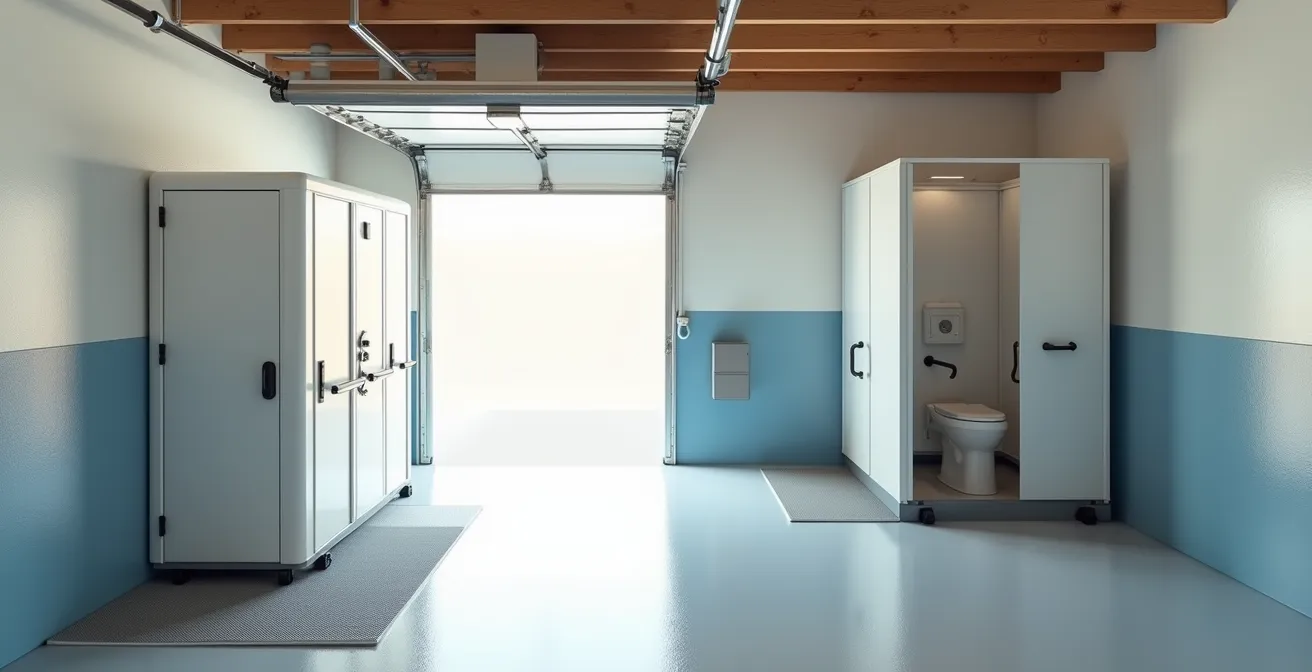
As shown in the image, a well-lit and organized space can be effectively converted for temporary use. Key elements include a portable shower unit with integrated grab bars, a stable platform with non-slip matting, and an accessible toilet with safety rails. Privacy screens are essential for creating a dignified space. The most critical factor is ensuring clear, level pathways to and from this temporary facility, free of any hazards. This approach not only solves the immediate problem but also minimizes the stress associated with living in a construction zone.
By planning for a temporary, fully-functional hygiene station, you transform a period of significant inconvenience into a manageable phase of the renovation project. This foresight is a crucial part of a successful and less stressful accessibility upgrade.
Load-Bearing vs. Partition Walls: Which Can Be Moved for Better Flow?
In any structural renovation, the central question is which walls can be removed or altered. The answer depends entirely on the wall’s function, a determination that has significant legal and engineering consequences. Walls in a home fall into two categories: partition walls and load-bearing walls. A partition wall serves only to divide space; its removal is typically a minor alteration. A load-bearing wall, however, is an integral part of your home’s skeleton, supporting the weight of the structure above it (such as a second floor or the roof). Removing one without proper procedure is not just ill-advised; it is a direct threat to your home’s structural integrity.
From a legal perspective, the distinction is black and white. Altering a partition wall may require a minor permit, but any modification to a load-bearing wall is a major structural change. For example, the Pennsylvania building code explicitly states that any work on a structural wall requires a permit. This is a universal rule across jurisdictions. This is because improper removal can lead to sagging floors, cracked drywall, and in the worst-case scenario, catastrophic collapse. Therefore, identifying a wall’s function is the non-negotiable first step, a task that must be performed by a qualified structural engineer or architect.
Distinguishing between these two types of walls involves several key indicators. While a professional assessment is mandatory, understanding these differences helps in the initial planning stages. The following table outlines the primary characteristics of each.
| Feature | Load-Bearing Wall | Partition Wall |
|---|---|---|
| Thickness | Over 12 cm | Thin bricks |
| Function | Supports structure weight | Simple dividing element |
| Sound when hit | Solid | Hollow |
| Permit needed | Major building permit | Minor building permit |
| Project required | Architectural project | No architectural project |
Ultimately, the decision to move a wall is not a DIY judgment call. It is a professional determination backed by engineering calculations and a formal permit process, ensuring the safety and legal compliance of your home.
The Demolition Mistake That Can Compromise Your Home’s Foundation
The single most dangerous demolition mistake during a structural renovation is the failure to install adequate temporary supports before altering a load-bearing wall. Homeowners and unqualified contractors often underestimate the immense, active forces these walls manage. Removing even a small section without first transferring its load can have immediate and severe consequences, not just for the floor above, but for the entire structural system, including the foundation. As experts from S3DA Design emphasize, removing a load-bearing wall’s framing without assembling temporary support is exceptionally dangerous because the floor joists may be resting directly on the wall. It is therefore imperative to build temporary supports on both sides to safely manage the load during demolition.
This isn’t merely a construction best practice; it’s a critical safety and liability issue. A failure at this stage can cause a cascading effect, where the shifting load creates new stress points on the foundation, leading to cracks, settling, and long-term instability. This can result in costly repairs and, from a legal perspective, places the homeowner in a position of significant liability. Any resulting damage would almost certainly not be covered by insurance due to the unpermitted and improper nature of the work. The proper procedure involves creating a temporary “surrogate” wall with adjustable steel posts and beams, which is a task for seasoned professionals, not a weekend project.
To avoid catastrophic errors, a systematic audit of the demolition plan is essential. This ensures every step is taken to protect your home’s structural integrity and foundation.
Your Pre-Demolition Safety Audit: 5 Points to Verify
- Temporary Support Installation: Confirm that a plan for installing temporary supports (e.g., adjustable steel posts, laminated veneer lumber beams) is in place and will be executed before any part of the existing wall is removed.
- Equipment and Vibration Control: Inventory the planned demolition equipment. Prohibit the use of heavy vibration tools like jackhammers directly on or near slab foundations to prevent cracking.
- Load Distribution Plan: Review the plans for the new permanent beam. Ensure it is designed to distribute weight evenly across its support points, avoiding dangerous “point load” errors that can over-stress the foundation.
- Utility Relocation Integrity: List all electrical, plumbing, and HVAC lines within the wall. Verify a licensed professional is contracted to handle their relocation safely and to code, preventing leaks or electrical hazards.
- Foundation Integrity Check: Before work begins, document the current state of the foundation. Plan for a post-demolition inspection to confirm that the modifications have not negatively affected the building’s foundational integrity.
In short, the integrity of your home’s foundation is directly linked to the professional execution of the demolition phase. Skipping the step of temporary support is a gamble with the highest possible stakes.
How to Finance Structural Renovations Using Home Equity Products?
Structural renovations for accessibility represent a significant financial investment, often exceeding the capacity of savings or unsecured loans. Fortunately, for homeowners, the equity built up in their property is a powerful financial tool that can be leveraged to fund these necessary modifications. Home equity products allow you to borrow against the value of your home, typically offering more favorable interest rates and terms than other forms of credit. Understanding the different types of home equity financing is crucial for choosing the option that best aligns with your project’s budget, timeline, and your personal financial situation.
The decision requires a careful review of your financial position and the project scope with a financial advisor. This process is as critical as reviewing architectural plans, as the financing structure you choose will impact your household budget for years to come. The three primary instruments are Home Equity Loans, Home Equity Lines of Credit (HELOCs), and Home Equity Investments. Each serves a different strategic purpose, from providing a single lump sum for a project with a fixed cost to offering a flexible credit line for ongoing or uncertain expenses.
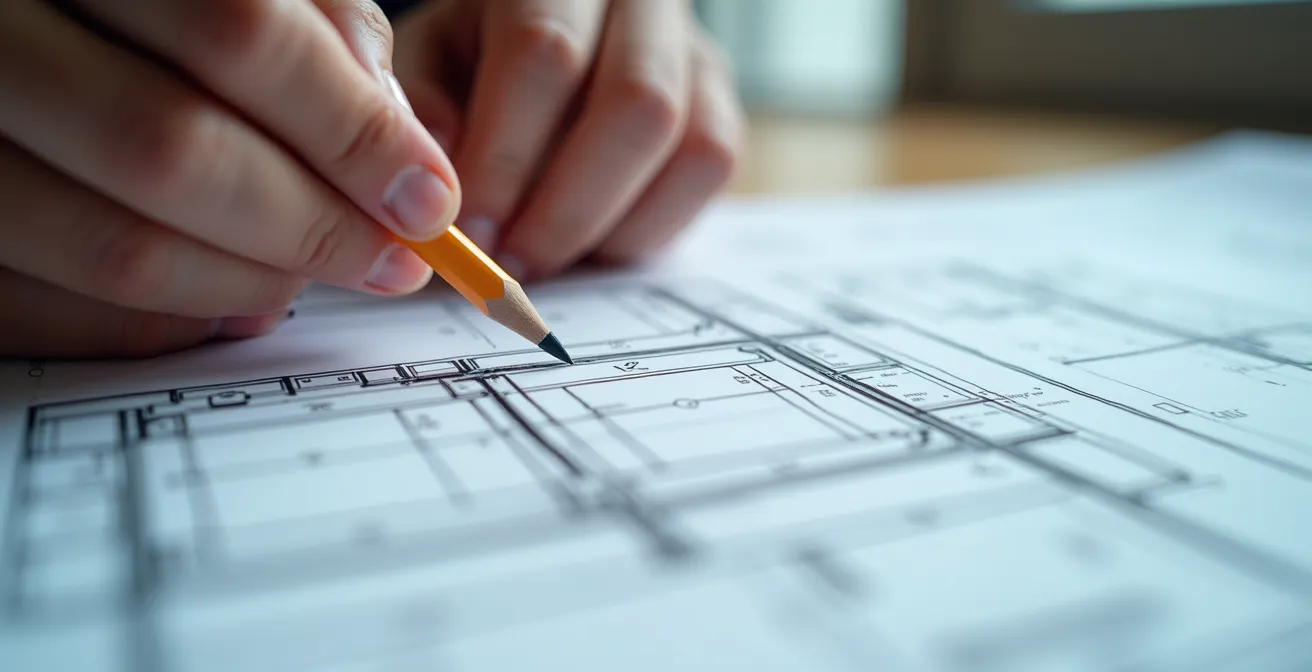
Choosing the right product is a matter of matching its features to your needs. A Home Equity Loan is ideal for a project with a well-defined scope and a firm quote from your contractor. A HELOC offers flexibility, making it suitable for projects where unexpected costs may arise. A Home Equity Investment is a less common but valuable option for those who want to access cash without taking on monthly debt payments.
| Financing Type | Best For | Key Features |
|---|---|---|
| Home Equity Loan | Fixed renovation budget | Fixed rate, lump sum, predictable payments |
| HELOC | Contingency funding | Variable rate, draw as needed, flexible access |
| Home Equity Investment | No monthly payments desired | Lump sum, no payments, share future appreciation |
By leveraging your home’s equity thoughtfully, you can transform a daunting expense into a manageable investment in your home’s long-term accessibility and value.
Certified Aging-in-Place Specialist vs. General Contractor: Who to Hire for Safety?
When undertaking a renovation focused on safety and accessibility, the choice of professional is arguably the most critical decision you will make. While any licensed general contractor can manage a construction project, not all possess the specialized knowledge required for aging-in-place modifications. This is where the distinction of a Certified Aging-in-Place Specialist (CAPS) becomes paramount. A CAPS is more than a contractor; they are a professional who has undergone specific training in the unique needs of the older adult population, universal design principles, and creating safe, barrier-free environments.
The difference in expertise directly translates to safety and long-term usability. A general contractor might install a grab bar, but a CAPS will know the precise height, angle, and structural reinforcement required by ADA guidelines to prevent failure under stress. They think beyond the immediate task, considering future needs and creating a holistic, safe environment. As the experts at Oakley Home Access state, this specialization is what makes them uniquely suited for this type of work.
Contractors with CAPS Certification are specifically trained in aging-in-place renovations, making them suitable for senior bathroom remodels
– Oakley Home Access, Senior Friendly Bathroom Designs Guide
Partnering with a CAPS provides confidence that the project is not just a cosmetic upgrade but a sound investment in quality of life. Homeowners who have worked with these specialists often report a greater sense of security, knowing that the design addresses both current and potential future challenges. This proactive approach is the hallmark of a true aging-in-place expert.
Ultimately, hiring a CAPS is an exercise in risk management. You are investing in an expert who understands the intersection of construction, design, and human physiology, ensuring your home is built not just to code, but to the standard of your life.
Why Asset Limits Disqualify You from Energy Assistance Programs?
Many homeowners seeking to fund accessibility modifications logically look towards government assistance programs. However, they often encounter a frustrating roadblock: being disqualified from programs like the Low Income Home Energy Assistance Program (LIHEAP) due to asset or income limits. The core reason for this is that these programs have a very narrow and specific mandate. They are designed to provide short-term relief for utility payments or weatherization, not to fund major capital improvements or structural home renovations. Their eligibility criteria, including strict income and asset thresholds, are tailored to identify households in immediate financial crisis related to energy costs.
For example, a program designed to help pay a heating bill will have a much lower income ceiling than one designed for home modification. The Access to Home Program requires income at or below 80% of the area median income, which in New York City was $90,720 for a one-person household, but even this is aimed at specific modifications, not general assistance. Consequently, homeowners who may have moderate savings or own their home outright—assets that are essential for securing loans for a major renovation—are often automatically disqualified from these niche assistance programs. This creates a “missing middle” dilemma, where households are not poor enough to qualify for grants but may not have the liquid cash for a $50,000 renovation.
This reality means that homeowners must look beyond energy assistance and explore funding avenues specifically designed for accessibility and home modification. The landscape of financial support is fragmented, but numerous specialized resources exist. The key is to shift the search from general aid to targeted grants and services.
- Apply for grants specifically designated for home accessibility modifications, which have different criteria than energy programs.
- Contact local Area Agencies on Aging (AAAs), which act as clearinghouses for regional resources and funding.
- Reach out to Centers for Independent Living (CILs), which are non-profit organizations that often have information on local grants.
- Explore disease-specific organizations (e.g., the ALS Association, National MS Society) that may offer grants for members needing modifications.
- Consider Medicaid waiver programs, which can sometimes be used for home and community-based services, including modifications.
- For veterans, investigate VA grants such as the Specially Adapted Housing (SAH) and Special Home Adaptation (SHA) programs.
- Hire a Geriatric Care Manager, a professional who specializes in navigating the complex web of senior services and funding options.
The journey to funding structural modifications requires a targeted approach. By focusing on programs dedicated to accessibility rather than general assistance, homeowners can find the specialized support needed to make their homes safe and livable for the long term.
Key takeaways
- Structural modifications are a matter of legal compliance; removing a load-bearing wall always requires a permit and professional engineering plans.
- The choice of professional is critical. A Certified Aging-in-Place Specialist (CAPS) offers specialized safety and design expertise that a general contractor may lack.
- Financing for major projects is often best achieved through home equity products, which should be chosen based on the project’s budget certainty and your personal financial strategy.
How to Design a Barrier-Free Ground Floor for Full Wheelchair Access?
Designing a barrier-free ground floor is the ultimate goal of many accessibility renovations. It goes beyond simply widening a single hallway; it involves creating a holistic environment where every essential space is seamlessly connected and fully usable from a wheelchair. This design philosophy, often called Universal Design, aims to create spaces that are inherently accessible to everyone, regardless of age or ability. Yet, despite its importance, it remains incredibly rare. A sobering report by the Harvard Joint Center for Housing Studies found that only 1% of U.S. homes have the key features for aging in place, such as zero-step entrances and wheelchair-accessible doorways.
Achieving a truly barrier-free layout requires a shift in thinking from isolated fixes to integrated design. It’s about creating logical “zones” and ensuring the “path of travel” between them is unobstructed. The most effective designs often center around a “Universal Design Triangle” that provides effortless flow between the three most-used areas: the bedroom, the bathroom, and the kitchen. This means ensuring not just wide hallways, but also zero-threshold transitions between rooms, accessible counter heights, and reachable controls. Every element of the design must be considered from the perspective of a seated user.
Creating this environment involves a detailed checklist of design elements. Each one contributes to a space that is not only compliant but genuinely comfortable and empowering for a wheelchair user. The focus must be on eliminating any and all physical barriers that impede movement or independent living.
- Implement wider hallways and doorways, aiming for a minimum of 36 inches for comfortable wheelchair passage.
- Install zero-threshold transitions between all rooms, eliminating bumps or changes in level that can stop a wheelchair.
- Lower light switches, thermostats, and electrical outlets to accessible heights within easy reach from a seated position.
- Choose smooth, hard flooring like Luxury Vinyl Plank (LVP) or hardwood over high-pile carpet or tile with wide, bumpy grout lines.
- Plan the layout in clear zones with defined pathways rather than large, undefined open spaces that can be difficult to navigate.
- Ensure all essential controls, including window mechanisms and appliance buttons, are within the standard forward and side reach ranges for a wheelchair user.
To put these principles into practice, the next logical step is to consult with a Certified Aging-in-Place Specialist (CAPS) who can translate these universal design concepts into an architectural plan tailored to your specific home and needs.