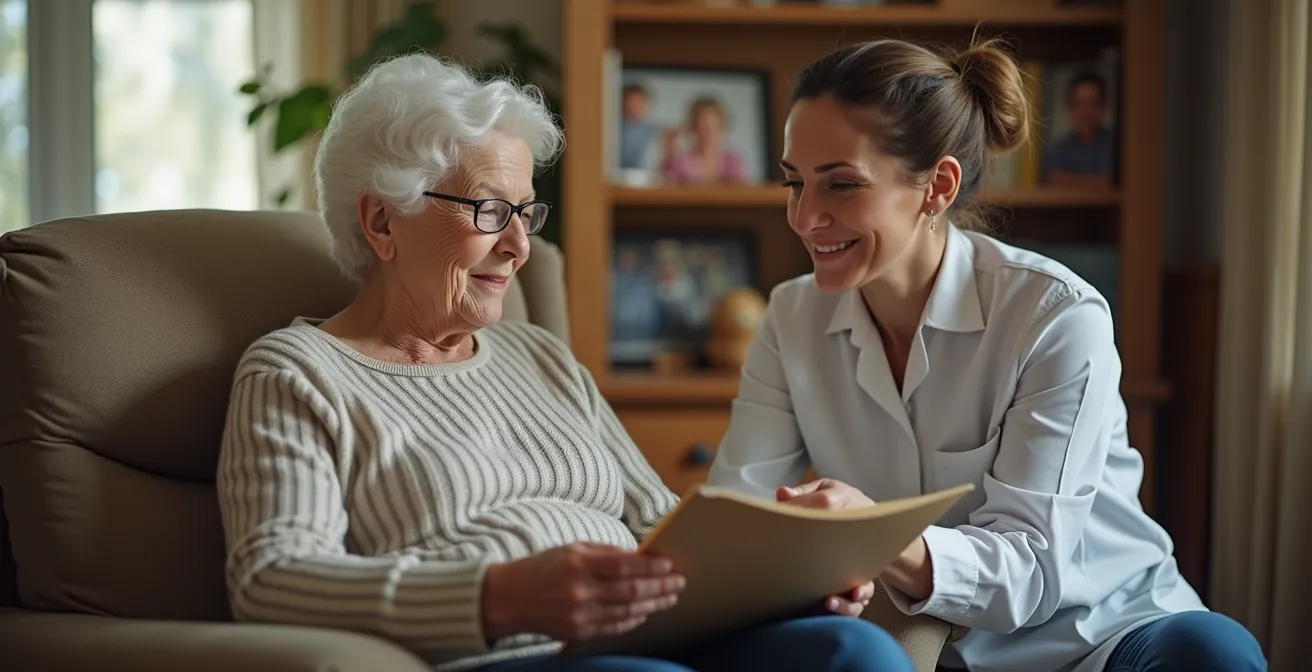
The decision to hire a licensed professional is not an admission of failure but a critical clinical intervention to manage medical risk at home.
- A caregiver’s legal “scope of practice” strictly defines what tasks they can perform, especially concerning medication and sterile procedures.
- Choosing between a CNA, LPN, and RN is a clinical triage based on the stability and complexity of the patient’s condition, not just the budget.
Recommendation: Shift your mindset from finding “help” to building a qualified clinical team, starting with a comprehensive care plan that defines medical tasks and protects your family from liability.
The moment a family realizes that friendly check-ins and help with groceries are no longer sufficient for an aging parent is a significant turning point. This transition is often marked by increasing medical complexity: a new diabetes diagnosis requiring insulin, a post-surgery wound that needs dressing, or a medication schedule that has become dangerously intricate. While the instinct may be to simply increase the hours of a beloved companion or non-licensed helper, this approach overlooks a critical legal and medical reality. The gap between social support and skilled nursing care is not a grey area; it is a bright line defined by law and professional standards.
Many families delay this transition, fearing the cost or the perceived clinical coldness of professional care. They attempt to manage complex needs with well-intentioned but unqualified individuals. This guide takes a different stance, viewing the move to a licensed professional not as a last resort, but as a proactive and necessary clinical intervention. It is a strategic decision to mitigate risk, ensure safety, and provide a higher standard of care. This is not about replacing companionship; it is about supplementing it with the appropriate level of medical expertise required to manage health conditions effectively and safely in a home environment.
Adopting this clinical mindset transforms the process. It shifts the focus from an emotional dilemma to a structured series of decisions. This article will provide a director-level framework for navigating this transition, covering the legal imperatives, the clinical triage of skill levels, the logistical systems for ensuring continuity of care, and the financial realities involved. We will deconstruct how to build a safe, effective, and person-centered home care system when medical needs become paramount.
This guide provides a structured path for making these critical decisions. Below, you will find a detailed breakdown of the key clinical and logistical checkpoints, from understanding legal boundaries to designing a truly comprehensive care plan.
Summary: A Clinical Framework for Medicalizing Home Care
- Why Unlicensed Helpers Cannot Administer Insulin Injections?
- How to Interview a Private Nurse for Compatibility?
- RN vs. LPN vs. CNA: Which Skill Level Does Your Parent Require?
- The ‘Compassion Fatigue’ Risk in Solo Professional Caregivers
- When to Implement a Shift Log to Ensure Medication Continuity?
- Hourly Rates vs. Live-In Rates: Where is the Financial Tipping Point?
- In-Patient Rehab Facility vs. Home Health Therapy: Which Yields Better Results?
- How to Design a Comprehensive Care Plan That Integrates Medical and Social Needs?
Why Unlicensed Helpers Cannot Administer Insulin Injections?
The administration of medication, particularly via injection, represents the most critical boundary between companionship and licensed medical care. An unlicensed helper, regardless of their experience or the family’s trust, is legally prohibited from performing tasks that require clinical assessment and sterile technique. This is not a matter of preference but of law, governed by the state’s Nurse Practice Act, which defines the scope of practice for licensed professionals. Administering insulin is far more than simply pushing a plunger; it involves calculating doses, assessing blood sugar levels, understanding the patient’s response, and managing potential complications like hypoglycemia.
Entrusting this task to an unlicensed individual exposes the family to significant legal and financial liability. In the event of an error—an incorrect dose, an unhygienic injection leading to infection, or a failure to recognize a critical symptom—the family, as the employer, could be held responsible. The legal complexities surrounding medication administration by non-medical personnel are significant; one analysis of a California Supreme Court case highlights the stringent legal frameworks built to protect vulnerable populations, even in settings like schools. These principles apply with equal force in a home care setting. The risk is not merely theoretical; it is a tangible threat to the patient’s health and the family’s security.
Therefore, the need for any injectable medication, routine wound care with sterile dressing, or any other invasive procedure is an unambiguous clinical indicator. It signals the definitive end of a companion’s scope and the mandatory start of a licensed professional’s role. This is the first and most important checkpoint in the decision to medicalize home support. Ignoring it is a breach of duty of care.
How to Interview a Private Nurse for Compatibility?
Once the clinical need for a licensed professional is established, the hiring process must shift from seeking a “helper” to recruiting a clinical team member. The interview is not merely about personality fit; it’s a crucial step to assess clinical competency, professional boundaries, and problem-solving skills. Compatibility in this context means finding a professional whose clinical approach aligns with the patient’s needs and whose communication style fosters trust with the family. A structured, behavior-based interview process is essential to move beyond subjective impressions.

Instead of asking generic questions like “Are you good with seniors?”, use situational inquiries that reveal how a candidate thinks and acts under pressure. For example: “Describe a time you had to manage a sudden change in a patient’s condition. What did you do?” or “How would you handle a situation where a family member’s request contradicts the established care plan?” These questions compel the candidate to provide concrete examples of their past behavior, which is the best predictor of future performance. As noted by one leading nursing resource, this structured approach removes guesswork.
The STAR method (Situation, Task, Action, Result) is a foolproof way to structure your response to a situational question
– Incredible Health Nursing Interview Guide, Most Common Nursing Interview Questions for 2025
Beyond clinical skills, the interview must also clearly establish professional boundaries. Discuss communication protocols, expectations for after-hours contact, and the nurse’s role as a clinical provider, not a family friend or housekeeper. This clarity prevents future misunderstandings and ensures the relationship remains focused on the patient’s medical well-being. The goal is to hire a competent clinical partner, and that requires a professional, evidence-based selection process.
RN vs. LPN vs. CNA: Which Skill Level Does Your Parent Require?
Choosing the right licensed professional is a clinical triage, not a simple menu of options. The titles Certified Nursing Assistant (CNA), Licensed Practical Nurse (LPN), and Registered Nurse (RN) represent distinct levels of training, clinical authority, and legal scope of practice. Making the correct choice is fundamental to both patient safety and cost-effectiveness. A CNA is ideal for providing hands-on assistance with Activities of Daily Living (ADLs) for a medically stable patient. They can help with bathing, dressing, mobility, and feeding but are generally not licensed to administer medication or perform sterile procedures.
An LPN (or LVN in some states) operates under the supervision of an RN or physician and is qualified to handle more complex, yet predictable, nursing tasks. This includes administering most oral and topical medications, performing routine wound care, monitoring vital signs, and managing stable chronic conditions like diabetes. An RN has the highest level of education and autonomy. They are essential for patients with unstable or complex conditions, fresh post-operative needs, or those requiring intravenous (IV) medications. Critically, only an RN can create and formally manage a comprehensive nursing care plan, conduct in-depth patient assessments, and make independent clinical judgments.
A cost-effective strategy often involves a blended team, where an RN creates the care plan and provides periodic supervision, while an LPN or CNA handles the day-to-day execution. This model leverages each professional’s skills appropriately. Data on nursing salaries reveals that LPNs can be significantly more cost-effective than RNs for many routine tasks, making a supervised team a financially sound approach. The following table from a leading nursing journal provides a clear framework for this decision-making process.
| Patient Condition | Recommended Caregiver | Key Tasks | Average Cost (2024) |
|---|---|---|---|
| Stable chronic conditions, daily living assistance | CNA | Bathing, feeding, mobility assistance | $35,760/year ($17.19/hour) |
| Predictable nursing tasks, stable wounds, scheduled injections | LPN | Medication administration, wound care, monitoring | $50,090/year ($24.08/hour) |
| Unstable conditions, fresh post-op, complex assessments | RN | Care plan creation, IV management, clinical decisions | $86,070/year ($41.38/hour) |
This decision should be made in consultation with the patient’s primary physician, who can provide a clear assessment of the required clinical skill level. Choosing an overqualified professional can be an unnecessary expense, while choosing an underqualified one is a direct threat to patient safety.
The ‘Compassion Fatigue’ Risk in Solo Professional Caregivers
Hiring a licensed professional is a major step, but it does not create an infallible system. Even the most dedicated nurse is susceptible to compassion fatigue and burnout, especially when they are the sole caregiver in a high-needs situation. Compassion fatigue is a state of emotional and physical exhaustion that can lead to a diminished ability to empathize or feel compassion for others. In a clinical setting, its symptoms can include increased medical errors, emotional detachment from the patient, and a decline in the quality of care. For families acting as employers, mitigating this risk is not just an act of kindness; it’s a critical component of quality assurance.
A solo caregiver, even a professional, working long hours without adequate breaks or support is on a direct path to burnout. The responsibility for preventing this falls on the employing family. Proactive strategies are essential. This includes implementing guaranteed, uninterrupted breaks during each shift, establishing a network of pre-vetted respite or PRN (“as-needed”) nurses for backup coverage, and setting firm communication boundaries to prevent non-emergency calls after hours. Rotating demanding tasks between multiple caregivers, if financially feasible, is another highly effective strategy. The goal is to build a sustainable care system, not to exhaust a single provider.

Ultimately, recognizing the caregiver as a human being with limits is paramount. Regular, scheduled check-ins to discuss their well-being, workload, and any challenges they face can identify early signs of stress before they escalate into full-blown burnout. Providing access to employee assistance programs for stress management can also be a valuable investment. A supported caregiver is an effective caregiver. An exhausted caregiver is a liability.
When to Implement a Shift Log to Ensure Medication Continuity?
A shift log is the central nervous system of a professional home care operation. It is the definitive tool for ensuring continuity of care, particularly when multiple people—be they licensed professionals or involved family members—share responsibility. A verbal handoff is insufficient and prone to error. A written or digital log becomes absolutely essential the moment care involves more than one person or when a single missed or double dose of medication could have severe health consequences. It transforms anecdotal observations into a legal medical record, providing a verifiable timeline of care.
Modern digital platforms have significant advantages over traditional paper logs. They provide real-time alerts, create a searchable history, and allow for easy data export for physicians. This is not just about convenience; it is about proactive error prevention.
Case Study: Digital Logs vs. Paper Logs in Preventing Medication Errors
Modern caregiving platforms like Caring Village and Lotsa Helping Hands offer significant advantages over paper logs. These digital solutions provide real-time mobile alerts when medications are given, maintain searchable history for medical appointments, and allow easy export of records for healthcare providers. One family reported that implementing a digital shift log prevented three potential medication errors in the first month alone by alerting family members to missed doses immediately rather than discovering issues hours later.
The level of detail is critical. A proper medication entry should include the exact time the dose was given, the dosage amount, the route of administration (e.g., oral, topical), the patient’s response, and any side effects observed. This granular data is invaluable for clinicians tracking treatment efficacy and adjusting the care plan. Furthermore, a detailed shift log serves as a crucial legal document. It protects both the caregiver and the family by providing documented, time-stamped evidence of the care provided and the medications administered, shielding all parties from potential liability claims.
Hourly Rates vs. Live-In Rates: Where is the Financial Tipping Point?
The financial component of professional home care is often the most significant barrier for families. Understanding the cost structures of hourly versus live-in care is essential for creating a sustainable plan. Hourly care is typically billed with a minimum shift requirement, often four hours, at a rate that can be 20-50% higher for nights and weekends. This model is best suited for part-time needs, such as assistance with morning routines, post-rehab therapy sessions, or specific task-oriented support throughout the day.
Live-in care operates on a different model, usually a flat daily rate. It’s crucial to understand that “live-in” does not mean 24/7 active care. The caregiver is entitled to sleep breaks (typically 8 hours) and meal breaks, and is there for supervision and assistance as needed. This option becomes the more financially viable choice when a continuous presence is required for safety and overnight supervision, rather than intensive, round-the-clock active care. The financial tipping point where live-in becomes more cost-effective than hourly care depends on the region and agency, but an analysis of senior care costs suggests this transition often occurs when a patient requires 8-10 hours of care per day.
Families must also account for hidden costs not always apparent in the base rate. The table below outlines these variables, helping to create a more accurate financial picture.
| Care Model | Base Cost | Hidden Costs | Best For |
|---|---|---|---|
| Hourly Care | $34-35/hour (4-hour minimum) | Weekend/overnight differentials (+20-50%), minimum shift requirements | Part-time needs, specific task assistance |
| Live-In Care | $250-350/day | Room and board, utilities, not 24/7 active care | Continuous supervision, overnight safety |
| Blended Model | Variable | Coordination costs between caregivers | High morning care needs, lighter evening supervision |
A blended model, combining fewer hours of highly-skilled RN or LPN care with a CNA or companion for supervision, can often provide the most effective balance of clinical support and cost management. The key is to base the financial plan on the documented clinical needs outlined in the care plan, not on an arbitrary budget.
In-Patient Rehab Facility vs. Home Health Therapy: Which Yields Better Results?
Following a significant medical event like a stroke, joint replacement, or major surgery, the question of where rehabilitation should take place is a critical one. The choice between a structured in-patient rehabilitation facility and therapy delivered at home is not just about convenience; it’s a clinical decision with profound implications for recovery outcomes. There is no one-size-fits-all answer, as the optimal environment depends heavily on the patient’s medical needs, cognitive status, and psychological disposition.
Home health therapy offers the undeniable comfort of familiar surroundings. For some patients, this psychological security can reduce stress and accelerate healing. The ability to practice navigating one’s own environment—getting in and out of their own bed, using their own bathroom—provides direct, practical benefits. However, this setting can also have drawbacks. The home may contain environmental hazards, and the lack of constant peer and professional interaction can lead to social isolation, which can be detrimental to cognitive recovery.
In contrast, an in-patient rehab facility provides a highly structured, intensive, and controlled environment. It offers access to specialized equipment and a multidisciplinary team of therapists on-site. The built-in social interaction with other patients can be a powerful motivator and a critical component of cognitive and emotional recovery. As highlighted in a longitudinal study on aging, social connectedness and support are fluid concepts that have a measurable impact on health trajectories. For some, the fresh environment of a rehab facility helps break old, dependent habits and fosters a mindset focused purely on recovery. The decision must be made in close consultation with the hospital discharge planner and the medical team, weighing the benefits of intensive, structured therapy against the psychological comfort of home.
Key Takeaways
- The need for any injectable medication or sterile procedure mandates the transition to a licensed professional (LPN or RN).
- Hiring a nurse requires a structured, behavior-based interview process (like the STAR method) to assess true clinical competency.
- A comprehensive care plan must be a dual-column document, explicitly integrating medical tasks with the patient’s personal and social goals to maintain their identity.
How to Design a Comprehensive Care Plan That Integrates Medical and Social Needs?
The care plan is the single most important document in a professional home care setting. It is the constitution that governs all activities, defines all roles, and ensures that care is consistent, safe, and aligned with the patient’s goals. A purely task-based checklist is insufficient. A truly comprehensive care plan must be a “personhood-centered” document that gives equal weight to both medical directives and the elements that define the patient’s identity and quality of life. This requires a deliberate, collaborative process.
The person’s identity isn’t erased by their medical needs – the plan’s first section should be ‘What Matters to Me,’ written from the senior’s perspective
– Transitions LifeCare, Resources and Support for Caregivers
The most effective method for creating this integrated plan is the dual-column approach. One column lists the non-negotiable medical and physical tasks with precise schedules (e.g., “Blood pressure check at 8 AM and 6 PM”). The parallel column lists the corresponding personhood and social goals that maintain the patient’s routine and sense of self (e.g., “Watch favorite news show during breakfast,” “Continue hobby of gardening with adapted tools”). This structure ensures that life-affirming activities are not pushed aside by the clinical regimen but are woven directly into it.
| Medical & Physical Tasks | Personhood & Social Goals |
|---|---|
| Morning medications (8 AM, 2 PM, 8 PM) | Watch favorite morning news show during breakfast |
| Blood pressure monitoring twice daily | Weekly video calls with grandchildren |
| Physical therapy exercises (30 min) | Continue hobby of gardening with adapted tools |
| Wound dressing changes | Maintain role as family recipe keeper |
| Dietary restrictions management | Social meals with friends twice weekly |
This plan should be created during a formal “Care Conference” involving the senior, key family members, and the newly hired licensed professional(s). This meeting ensures buy-in from all parties and establishes clear communication protocols from day one. The following checklist outlines the essential steps for a successful implementation.
Action Plan: Implementing the Comprehensive Care Conference
- Schedule a kickoff meeting with the senior, family, and all caregivers (new and existing) to establish a unified team.
- Begin the meeting by having the senior articulate their personal goals, preferences, and what “a good day” looks like to them.
- Review all medical needs and physician’s orders, creating an integrated task schedule using the dual-column method.
- Define and document clear communication protocols, including primary points of contact, shift log procedures, and emergency plans.
- Finalize the care plan document and have all involved parties sign it, acknowledging their roles and responsibilities.
To ensure a safe and effective transition to professional care, the next step is to formally document these requirements in a comprehensive care plan. This foundational document serves as the clinical and legal cornerstone of your home care strategy.
Frequently Asked Questions About When to Transition from a Companion to a Licensed Professional Caregiver?
When is a shift log absolutely necessary?
A shift log becomes essential when care responsibility is shared by more than one person (including multiple family members) OR when a single missed or double dose has severe health consequences.
What legal protections do shift logs provide?
Shift logs serve as legal medical records that protect both caregivers and families from liability claims, providing documented evidence of care provided and medications administered.
How detailed should medication documentation be?
Documentation should include exact time given, dose, route of administration, patient response, and any side effects observed – this data is essential for clinicians to track treatment efficacy.