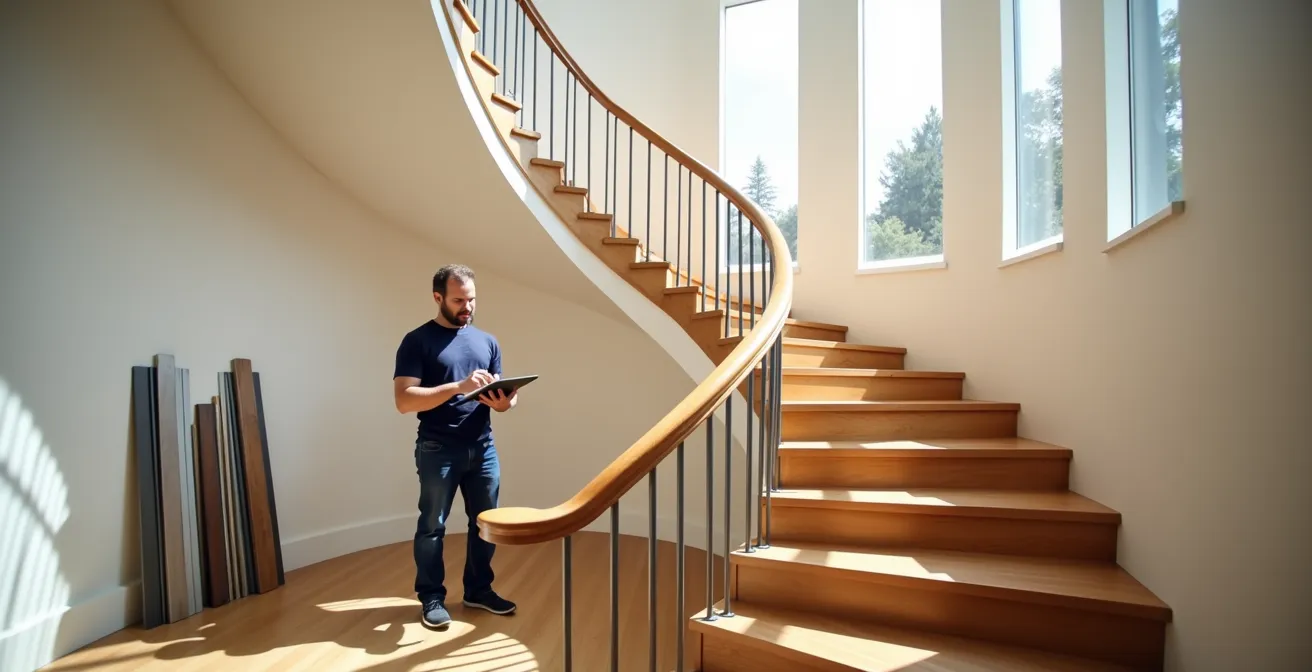
The steep price of a curved stairlift isn’t arbitrary; it directly reflects a complex process of precision engineering, custom manufacturing, and skilled installation required for safety on a non-standard staircase.
- The rail, which must perfectly match every curve and angle of your stairs, is always custom-fabricated and constitutes the bulk of the cost.
- Advanced measurement technology like photogrammetry is often used to ensure a millimeter-perfect fit, a process far more involved than a simple tape measure.
Recommendation: Instead of focusing solely on the initial price, evaluate the cost based on the manufacturing process, warranty details, and the long-term value of preventative maintenance.
Receiving a quote for a curved stairlift can be a shocking experience, especially when compared to the price of a straight model. It’s common for families to wonder if the significant price jump—often 30% or more—is truly justified. The immediate answer you’ll hear is “the rail is custom-made,” but that simple phrase barely scratches the surface. It fails to convey the intricate dance of logistics, engineering, and skilled labor that goes into creating a machine that must safely navigate the unique geometry of your home.
The reality is that a straight stairlift is an off-the-shelf product, while a curved stairlift is a bespoke piece of medical equipment, more akin to a custom prosthetic than a simple appliance. The process involves far more than just bending a piece of metal. It begins with precise digital mapping of your staircase and ends with an installation that requires meticulous adjustment to ensure a smooth, stable ride. Understanding this entire value chain is the key to moving past the initial sticker shock and making an informed, confident decision for your family’s mobility and safety.
This article will provide a transparent breakdown of exactly where the costs come from. We will explore the differences in manufacturing, the nuances of measurement, the trade-offs of reconditioned models, and the critical importance of proper installation and maintenance. By demystifying the process, we aim to empower you with the knowledge to assess the true value of a curved stairlift investment.
text
To help you navigate this important decision, this guide breaks down the key factors influencing the cost and functionality of custom stairlift solutions. Explore the topics below to understand what drives the price and how to choose the right option for your home.
Summary: A Comprehensive Guide to Curved Stairlift Costs and Mobility Solutions
- Why Modular Rails Are Faster to Install Than Bespoke Welded Rails?
- How to Measure Your Staircase for a Remote Stairlift Quote?
- New vs. Reconditioned Curved Lifts: Is the Savings Worth the Warranty Risk?
- The ‘Tight Turn’ Mistake That Leaves Knees Hitting the Banister
- When to Schedule Service to Prevent Rail Friction and Motor Burnout?
- When to Install a Platform Lift Instead of a Ramp for High Porches?
- How to Fold and Load a Rollator into a Car Trunk Alone?
- 1-Motor vs. 2-Motor Lift Chairs: Which Provides Better Back Support for Nap Taking?
Why Modular Rails Are Faster to Install Than Bespoke Welded Rails?
The single biggest factor in the cost and installation time of a curved stairlift is the rail. There are two primary manufacturing philosophies: traditional bespoke welded rails and modern modular systems. A bespoke rail is a single piece of steel, custom-bent and welded in a factory to match a 3D model of your staircase perfectly. This process is precise but has a significant fabrication lead time of 4 to 8 weeks, plus international shipping.
In contrast, a modular rail system, like Acorn’s FastTrack®, uses a series of pre-manufactured straight and curved sections that are assembled on-site. An installer selects the correct pieces from a local stock to build a rail that follows the path of your staircase. This dramatically cuts down the timeline. As the Acorn case study highlights, this allows for installation ‘in a matter of days’ instead of waiting weeks for a custom-welded rail. The key is in the precision-engineered connections and self-leveling carriage that ensure a smooth ride despite the joints.
While a bespoke rail may offer a slightly sleeker, continuous look, the modular approach offers unparalleled speed. The installation itself is also often faster, taking 2-5 hours for a modular system versus 5-8 hours for a bespoke one, which requires more precise mounting. It’s a trade-off between custom craftsmanship and logistical efficiency, with modular systems providing a safe and reliable solution much more quickly.
How to Measure Your Staircase for a Remote Stairlift Quote?
Getting an initial “ballpark” quote for a curved stairlift often starts with you providing measurements and photos. While this can’t replace a professional survey, providing accurate information from the start helps a supplier determine feasibility and provide a more realistic preliminary estimate. The goal is to capture the staircase’s entire path and identify any potential obstructions.
To do this effectively, you’ll need to take a specific series of photos and measurements:
- Full Views: Stand at the bottom and take a photo looking all the way up, then go to the top landing and take another looking all the way down. This captures the overall flow and number of turns.
- Tightest Curve: Take a close-up picture of the tightest corner or bend. This is a critical point for the rail design.
- Obstructions: Photograph any radiators, window sills, or doorways that are close to the staircase path.
- Key Dimensions: Measure the total vertical height from the bottom floor to the top landing and the overall length of the staircase along its outer edge. Including a measuring tape in your photos for scale is also extremely helpful.

However, it’s crucial to understand the limits of this DIY approach. While your photos provide an estimate, the final manufacturing is based on a professional survey, often using photogrammetry. This technology uses specialized photos to create a precise 3D digital model, ensuring a millimeter-perfect fit. Silver Cross emphasizes that DIY measurements provide ‘ballpark’ estimates only; the professional survey is non-negotiable for a custom build. It’s also important to remember that stairlifts are fixed to the stair treads, not the wall, so wall damage is not a concern.
New vs. Reconditioned Curved Lifts: Is the Savings Worth the Warranty Risk?
One of the most common questions from families facing a high quote is whether a reconditioned (or refurbished) stairlift is a viable way to save money. The answer is yes, but it comes with critical caveats. A reconditioned lift can offer savings of 25-30%, but you must understand what is new and what is used. As Lifeway Mobility’s guide clearly states, “The track must be custom-made for each individual staircase.”
The track must be custom-made for each individual staircase
– Lifeway Mobility, Stair Lift Pricing Guide 2026
This means that even with a reconditioned purchase, you are paying for a brand-new, custom-fabricated rail. The savings come from the chair chassis and motor, which have been refurbished. This “hybrid” approach, as demonstrated by Independent Living Solutions’ program, is a sound way to reduce costs while maintaining the most critical safety component—the rail. The risk, therefore, lies entirely with the pre-owned mechanical and electrical parts.
This table breaks down the key differences to help you assess the financial risk. While the initial savings are attractive, a potential motor failure in the second year could erase them entirely.
| Aspect | New Curved Stairlift | Reconditioned Curved Stairlift |
|---|---|---|
| Initial Cost | $11,000-$15,000+ | $8,000-$12,000 (25-30% savings) |
| Rail Component | Brand new custom-made | Brand new custom-made (rails cannot be reused) |
| Chair/Motor | New with full warranty | Refurbished with limited warranty |
| Warranty Coverage | 2-5 years comprehensive | 90 days to 1 year on reconditioned parts |
| Battery Life | 3-5 years expected | 1-3 years (depending on prior use) |
| Break-even if motor fails | N/A | Year 2 (typical motor replacement $800-$1,500) |
The decision hinges on your risk tolerance. A new lift offers peace of mind with a comprehensive, multi-year warranty. A reconditioned lift offers immediate savings but carries the risk of earlier-than-expected repair costs and shorter battery life. Some companies may also offer rental options for straight lifts, but this is very rare for curved models due to the custom rail.
The ‘Tight Turn’ Mistake That Leaves Knees Hitting the Banister
One of the most complex challenges in curved stairlift design is navigating a tight turn, such as on a spiral staircase or a 90-degree landing. This is where precision engineering truly justifies the cost. The primary goal is to maintain adequate clearance geometry, ensuring the rider’s knees do not hit the opposing wall or banister as the chair swivels around the bend. A few millimeters can be the difference between a comfortable ride and an unusable lift.
To achieve this, engineers design the rail to follow a very specific path—sometimes hugging the inside track, sometimes the outside—and program the chair’s powered swivel function to rotate at the perfect moment. This ensures the user’s body stays within the safe zone of the staircase’s width. This is also why a minimum staircase width is a non-negotiable requirement for a safe installation.
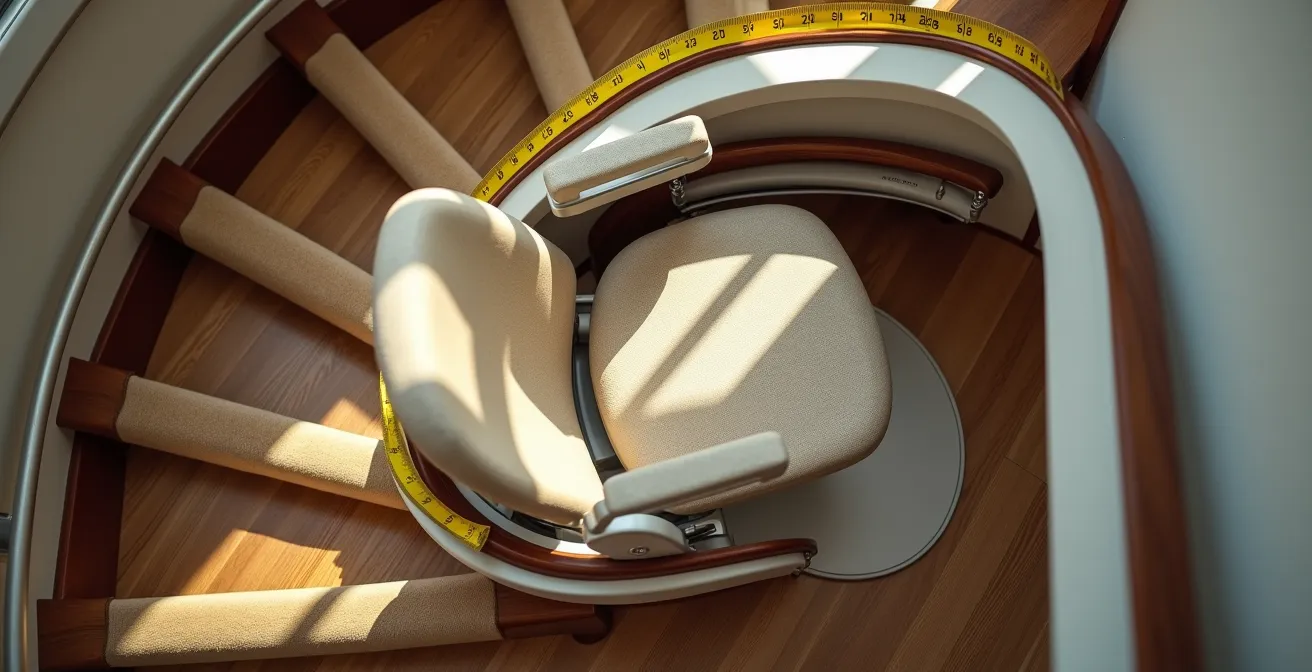
For a standard installation, industry standard measurements indicate the stairway needs to be at least 30″ wide. However, on tight turns, this can be insufficient if the user’s leg length (from hip to knee) isn’t factored in. A reputable installer will take this measurement during the survey. An improperly designed rail path is a costly mistake that can render the entire system unsafe or uncomfortable, highlighting why professional, on-site surveys using advanced tools are so critical.
When to Schedule Service to Prevent Rail Friction and Motor Burnout?
The initial purchase price is only part of the total cost of ownership. Just like a car, a stairlift is a complex machine that requires regular maintenance to ensure its longevity and prevent costly emergency repairs. The most common points of failure on a neglected unit are the motor and batteries, often due to increased strain from friction and torsion on the rail. Proper service can help a stairlift last 10+ years, while neglected units can fail in as few as three.
Most manufacturers recommend an annual professional service, which typically involves lubricating moving parts, testing safety circuits, checking battery health, and ensuring the rail is perfectly aligned. Professional service data shows it’s wise to budget $100–$200 for annual maintenance, a small price compared to an emergency motor replacement that can cost between $800 and $1,500. However, the service schedule isn’t one-size-fits-all. As service pattern analysis shows, usage frequency is a key factor. A stairlift used over 20 times per day or by a user weighing over 250 pounds will benefit from a 6-month service interval to prevent premature wear.
In between professional visits, you can perform simple monthly checks to catch problems early. This proactive approach helps maintain smooth operation and can extend the life of your investment significantly.
Your 5-Minute Monthly Stairlift Inspection Checklist
- Listen for new grinding or squeaking sounds during operation, which indicates friction issues.
- Wipe the rail clean of dust and debris using a dry microfiber cloth to prevent buildup that causes resistance.
- Test all emergency stop sensors and buttons at the top and bottom to ensure safety systems function correctly.
- Check the battery indicator lights on the unit to verify its charging status and prevent unexpected power loss.
- Inspect the seat swivel mechanism for smooth rotation at the top and bottom landings to detect mechanical issues early.
When to Install a Platform Lift Instead of a Ramp for High Porches?
When outdoor access is the challenge, many people first think of a ramp. However, for porches or decks with significant height, a ramp is often impractical due to the immense space it requires. For safe, unassisted wheelchair use, the Americans with Disabilities Act (ADA) recommends a 1:12 slope ratio, meaning for every 1 inch of vertical rise, you need 12 inches of ramp length. This adds up quickly.
A simple calculation demonstrates the issue: ADA compliance calculations demonstrate that a 36-inch high porch requires a 36-foot long ramp. That’s longer than a school bus. For most residential properties, dedicating that much yard space is not feasible, not to mention the significant visual impact it has on your home’s curb appeal. This is the scenario where a Vertical Platform Lift (VPL) becomes the superior solution.
A VPL, essentially a mini home elevator, has a much smaller footprint and provides a safer, more dignified transfer. While the initial installation cost is higher than a ramp, the overall benefits in terms of space, caregiver effort, and all-weather usability often make it the more practical and valuable long-term investment, as this comparison shows.
| Factor | Vertical Platform Lift | 36-foot Aluminum Ramp |
|---|---|---|
| Space Required | 5′ x 5′ footprint | 36′ linear + landings |
| Installation Cost | $8,000-$15,000 | $3,000-$8,000 |
| Caregiver Effort | Push button operation | Physical push up incline |
| Weather Impact | Covered platform | Exposed to rain/ice |
| Property Value Impact | Minimal visual impact | Significant curb appeal reduction |
| Maintenance | Annual service $200-300 | Surface treatment yearly |
How to Fold and Load a Rollator into a Car Trunk Alone?
Beyond the home, maintaining mobility often involves transporting walking aids like rollators. For someone living alone or with limited strength, lifting a 20-25 pound rollator into a car trunk can be a significant barrier. The key to accomplishing this safely and independently is not brute strength, but proper technique and leverage.
The first step is choosing the right equipment. Market analysis shows that modern carbon fiber rollators weighing 11-15 pounds are significantly easier to handle than older steel models. Furthermore, models with one-hand folding mechanisms, like the Drive Medical Nitro Euro Style, are a game-changer. Its cross-brace design allows it to be folded with a single motion while the brakes remain locked, preventing the common and frustrating problem of the rollator unfolding as you try to lift it.
Once you have a suitable rollator, the following leverage technique minimizes the amount of direct lifting required:
- Position and Secure: Place the rollator parallel to the trunk opening and engage the parking brakes firmly.
- Fold: Use the one-hand release mechanism to collapse the rollator into its most compact form.
- Tilt and Pivot: Tilt the folded rollator against the lip of the trunk at a 45-degree angle. The trunk edge now acts as a fulcrum.
- Slide, Don’t Lift: Grab the bottom wheels and lift them up while pushing the top of the rollator forward. Use the momentum to slide it into the trunk rather than trying to lift the entire weight at once.
- Secure for Travel: Use a simple bungee cord attached to the trunk’s anchor points to keep the rollator from sliding around while driving.
Key Takeaways
- The primary cost of a curved stairlift lies in the custom-fabricated rail, which is always brand-new, even on reconditioned models.
- Modular rail systems offer a faster installation timeline by using pre-stocked components, while bespoke rails require weeks of factory production.
- Preventative annual maintenance is a small investment that can prevent costly motor burnouts and more than double the lifespan of your lift.
1-Motor vs. 2-Motor Lift Chairs: Which Provides Better Back Support for Nap Taking?
For many, a lift chair is more than just a tool for standing up; it’s a primary place for rest and even napping. When it comes to long-term comfort and proper back support, the number of motors in the chair makes a profound difference. A 1-motor chair operates with a fixed recline ratio: as the back reclines, the footrest rises in a predetermined, linked motion. This offers limited positions and can create pressure points on the lower back if the angle isn’t perfect for your body.
A 2-motor chair, however, offers independent control over the backrest and the footrest. This is the key to achieving superior back support. It allows for infinite micro-adjustments to find a neutral spinal position, which is essential for comfortable napping without waking up sore. The added cost of $200-$400 for a second motor directly translates into a higher degree of ergonomic customization.
As experts in medical equipment ergonomics point out, this independent adjustment is what enables true spinal alignment and pressure relief.
A 2-motor chair allows micro-adjustments to perfectly align the hips and spine for a neutral position, which is crucial for napping
– Medical Equipment Analysis, Ergonomics of Infinite Position Technology
This capability allows a 2-motor chair to achieve a “zero-gravity” position, where the feet are elevated slightly above the heart. This position optimally decompresses the spine and improves circulation, something a 1-motor chair cannot fully replicate. The choice depends on usage: for simple sit-to-stand assistance, a 1-motor chair may suffice. For anyone planning to spend significant time resting or napping in the chair, the 2-motor system is a worthwhile investment in health and comfort.
| Feature | 1-Motor System | 2-Motor System |
|---|---|---|
| Recline Ratio | Fixed 1:1 ratio | Independent adjustment |
| Lower Back Support | Limited positions | Infinite micro-adjustments |
| Zero-Gravity Position | Not achievable | Full replication possible |
| Footrest Above Heart | Only in full recline | Multiple positions available |
| Spinal Decompression | Partial relief | Optimal alignment achievable |
| Price Difference | Base price | +$200-400 premium |
Now that you have a transparent understanding of the engineering, labor, and options involved, the next logical step is to apply this knowledge to your specific situation. Requesting a no-obligation, in-home survey from a reputable specialist will provide you with a precise quote based on your home’s unique layout and your personal mobility needs.